
1 November 2026
By Tom Collins
tom@TheCork.ie
217 new homes but with no residential car parking spaces
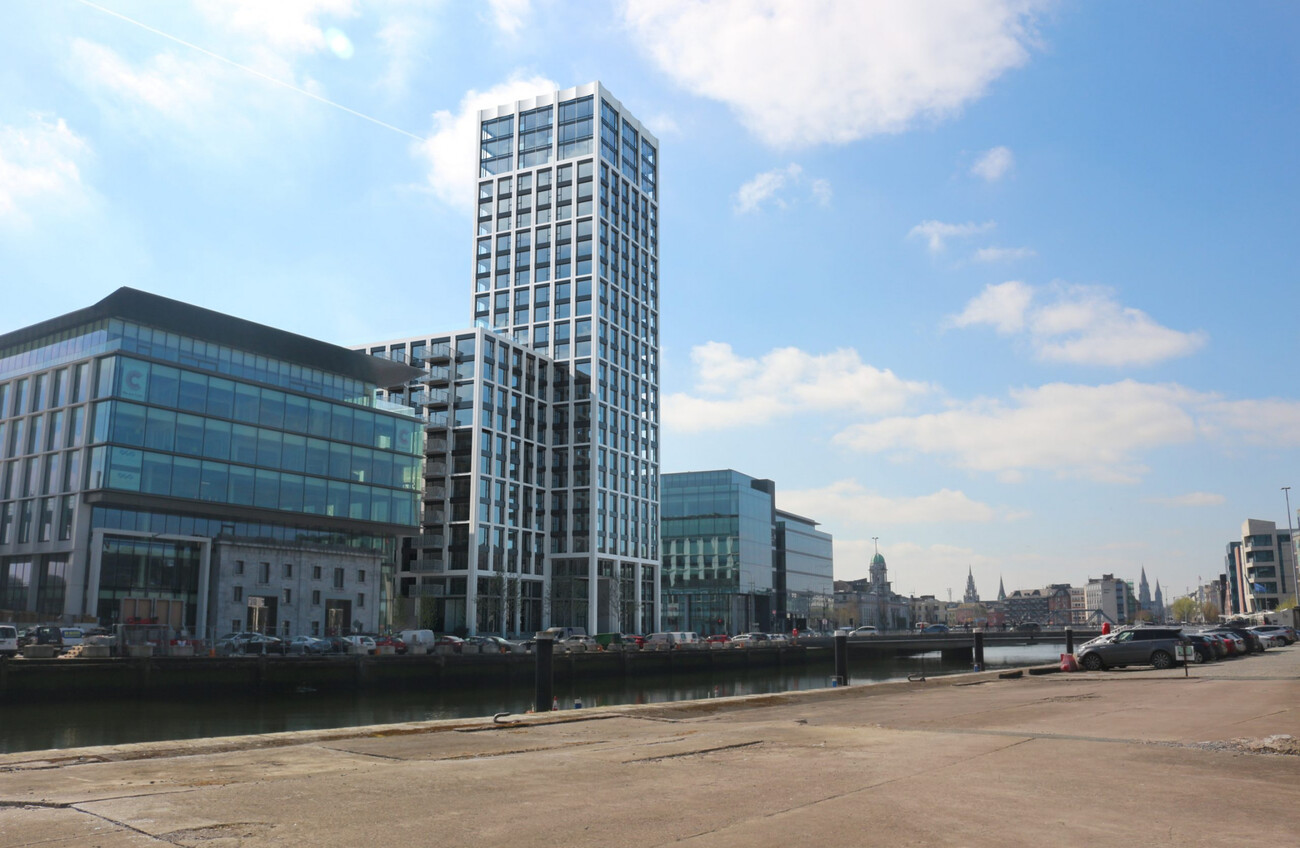
Computer generated image of what the building will look like. It has white tracery. There is a tall section on the right which is a tower, and a lower mass on the left
Cork City centre’s 25-storey ‘Railyard Apartments‘, at the corner of Albert Quay, will provide 217 apartments and 315 bicycle spaces, with residents expected to rely on public transport. But will a car-free approach work for everyone?
If we conservatively estimate that each apartment will accommodate two people, that could mean 434 new residents living in this part of Cork City. Instead of providing car parking, the development will have 315 bicycle spaces, with its central location intended to encourage residents to walk, cycle and use public transport.
Operated by housing charity and Approved Housing Body Clúid, the project will comprise 99 social housing apartments for Council tenants, with the remaining homes offered through the Cost Rental scheme.

The absence of an underground car park is a significant feature of the development, with Clúid opting to avoid the considerable expense associated with constructing parking facilities beneath the building. Indeed, developments that do provide parking often have two underground levels, and building so close to the river would make that prospect particularly expensive.
A skyscraper – if we can use that term – without car parking is noteworthy. There are numerous international examples of this approach, such as in Toronto. Some think tanks suggest that, in the future, we may no longer need to own cars or require dedicated parking spaces. Instead, we could simply summon a self-driving vehicle for pick-up and drop-off.
However, there are practical considerations. Tradespeople, for example, will always need somewhere to keep their vans and tools. Parents of young children may also find it difficult to manage without a car, given the need for child seats, buggies and all the other equipment that comes with family life.
Will residents really be able to live without a car?
The thinking behind the development is that residents will not need cars because of the availability of public transport, including bus services, and the building’s central location.
However, the reality of everyday life is not always so straightforward.
While some residents may be able to rely entirely on buses, cycling and walking, others may find that their employment circumstances make owning a car unavoidable.
A job may take priority over where someone lives, and not every workplace is conveniently served by public transport. Shift work, early starts, late-night finishes and employment outside the city centre could all make having a car a practical necessity.
There is also the reality that people’s circumstances can change. Someone who moves into an apartment without needing a car could subsequently take up a job that requires one.
The absence of parking will present a challenge for some residents, who may have to pay for parking elsewhere, potentially adding to pressure on existing parking facilities in the surrounding city centre. Others may look further afield and park in the suburbs.
Hundreds of new residents
The 217 apartments will comprise one-bedroom and two-bedroom homes, meaning the building could accommodate several hundred people once fully occupied.
Clúid says rents at The Railyard will be approximately 29% below local market rates; being expected to range from €1,425 to €1,575 for one-bedroom apartments, while two-bedroom homes will cost approximately €1,725.
Cost Rental accommodation is aimed at people who earn too much to qualify for social housing yet still struggle to afford private rents. In this development, the income threshold is a net annual income of €59,000 or less.
A long-term housing project
Clúid’s have said the development represents a major investment in long-term housing provision.
The organisation will oversee the building and its tenants for at least 50 years, with higher-quality materials being used to reduce maintenance costs and disruption over time.
The development is also part of a changing approach to Cost Rental, which Clúid increasingly views as permanent housing rather than a temporary stepping stone towards homeownership.
Applications are expected to open within the next three months, with residents due to move in late next year.
For a brief period, Cork’s Railyard will hold the title of Ireland’s tallest residential building, until the Land Development Agency’s 30-storey Parkgate Pointe development near Dublin’s Heuston Station is completed in 2028.
Interested in this skyscraper carparking?
Check out this video about the opposite, a Chicago 1960’s skyscraper with 19 stories of car parking.