
23 September 2026
By Roger Kennedy
roger@TheCork.ie
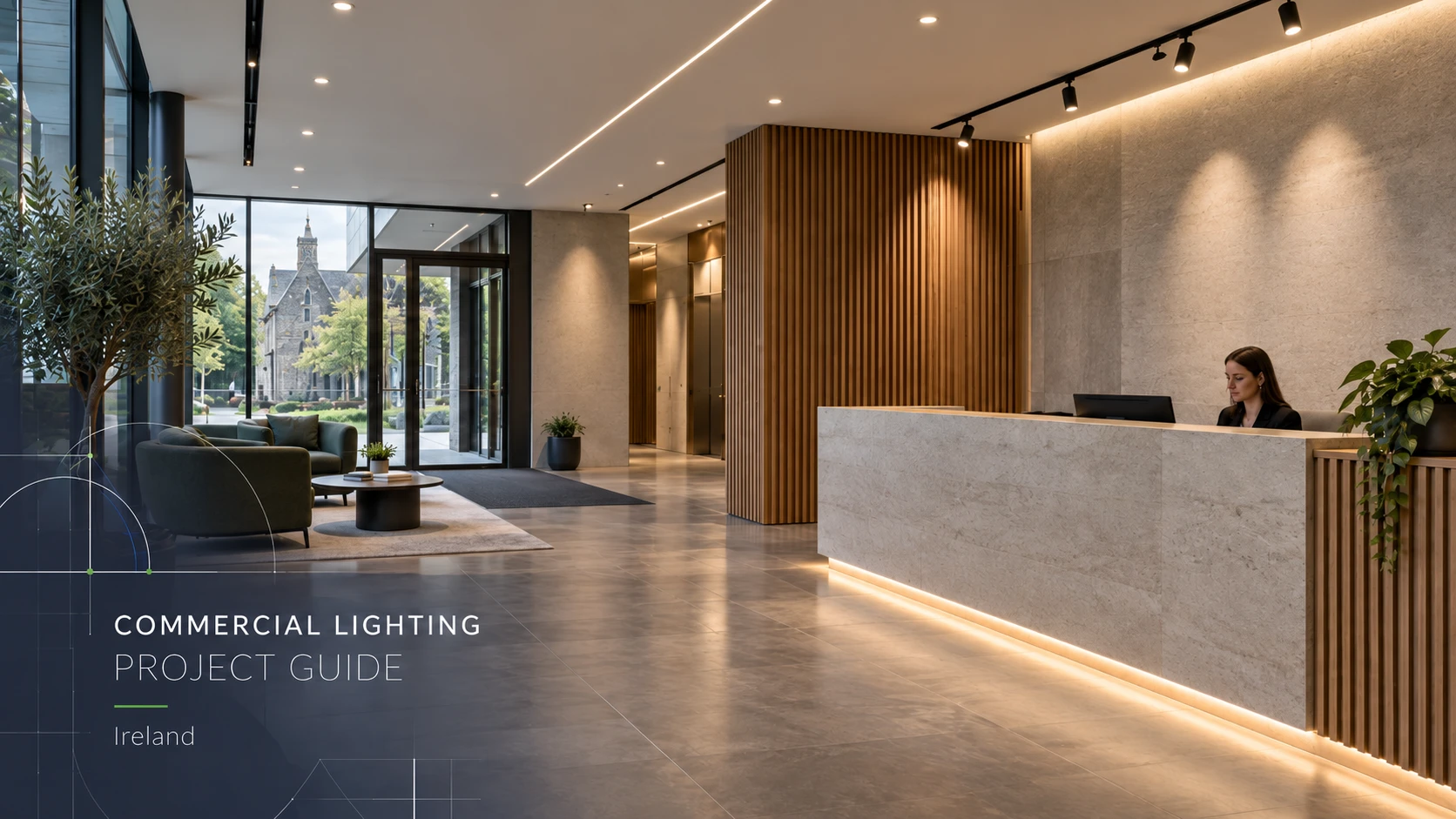
For Irish businesses, upgrading to LED lighting can look deceptively simple: replace older fittings, reduce wattage and expect lower running costs. In a commercial environment, however, a successful lighting upgrade depends on much more than energy consumption alone.
Offices, retail spaces, hospitality venues, warehouses and other commercial premises all place different demands on a lighting system. Light distribution, operating hours, colour quality, controls, maintenance, installation conditions and the way a space is actually used should all influence the specification.
For businesses considering an upgrade, looking beyond the headline wattage can make the difference between simply replacing old fittings and creating a lighting system that works effectively for years to come.
Start with the space, not the fitting
One of the easiest mistakes to make is choosing a luminaire before considering what the space actually needs.
A warehouse with high ceilings has very different requirements from an office, while a retail environment may need a combination of general illumination and focused accent lighting. Hospitality spaces introduce another set of priorities, where atmosphere and visual comfort can be as important as practical illumination.
Before selecting products, businesses and contractors should consider:
- What activities take place in the space?
- How high are the ceilings and where can fittings be positioned?
- How many hours per day will the lighting operate?
- Is the area exposed to moisture, dust or changing weather conditions?
- Is accurate colour appearance important?
- Will different areas require separate switching, dimming or controls?
- How accessible will the fittings be for future maintenance?
Answering these questions first makes product selection considerably more straightforward.
Energy efficiency is important — but it is not the whole specification
Lower energy consumption remains one of the strongest reasons for moving from older lighting technologies to modern LED systems. In premises where lighting operates for long periods, even relatively small reductions in installed load can become significant over time.
However, comparing fittings purely by wattage can be misleading. A lower-wattage product is not automatically the better choice if its light output, distribution or suitability for the installation is inadequate.
The objective should be to deliver the required lighting effectively while using energy efficiently, rather than simply selecting the smallest wattage available.
Different commercial environments need different solutions
There is no single LED fitting that is ideal for every commercial application.
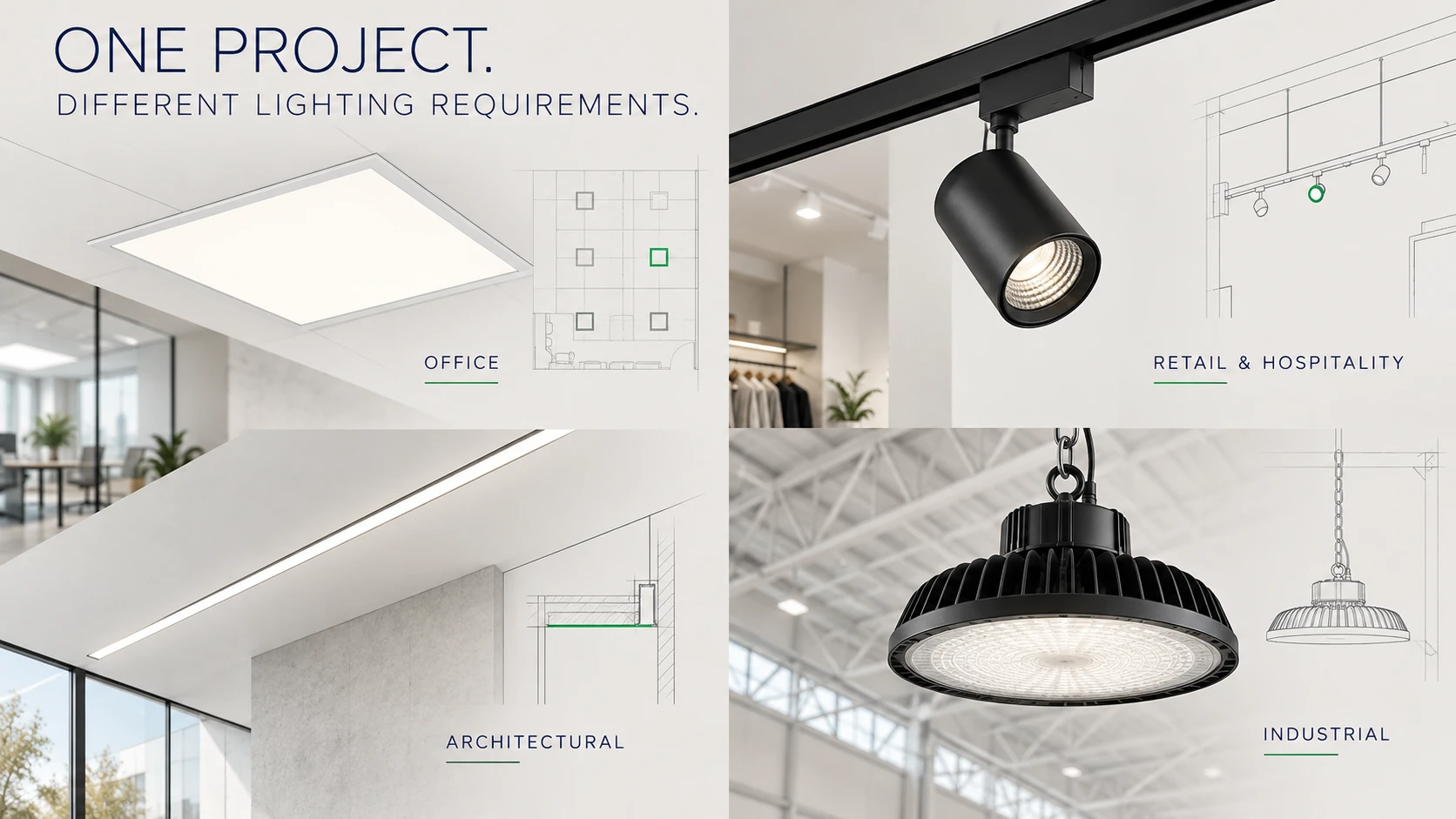
Offices generally benefit from comfortable, evenly distributed illumination designed around work areas, circulation spaces and meeting rooms. Glare, colour temperature and visual comfort can matter just as much as efficiency.
Retail and hospitality environments often require a more layered approach. Track lighting, downlights, linear systems and architectural lighting can be combined to provide general illumination while drawing attention to displays, counters or architectural features.
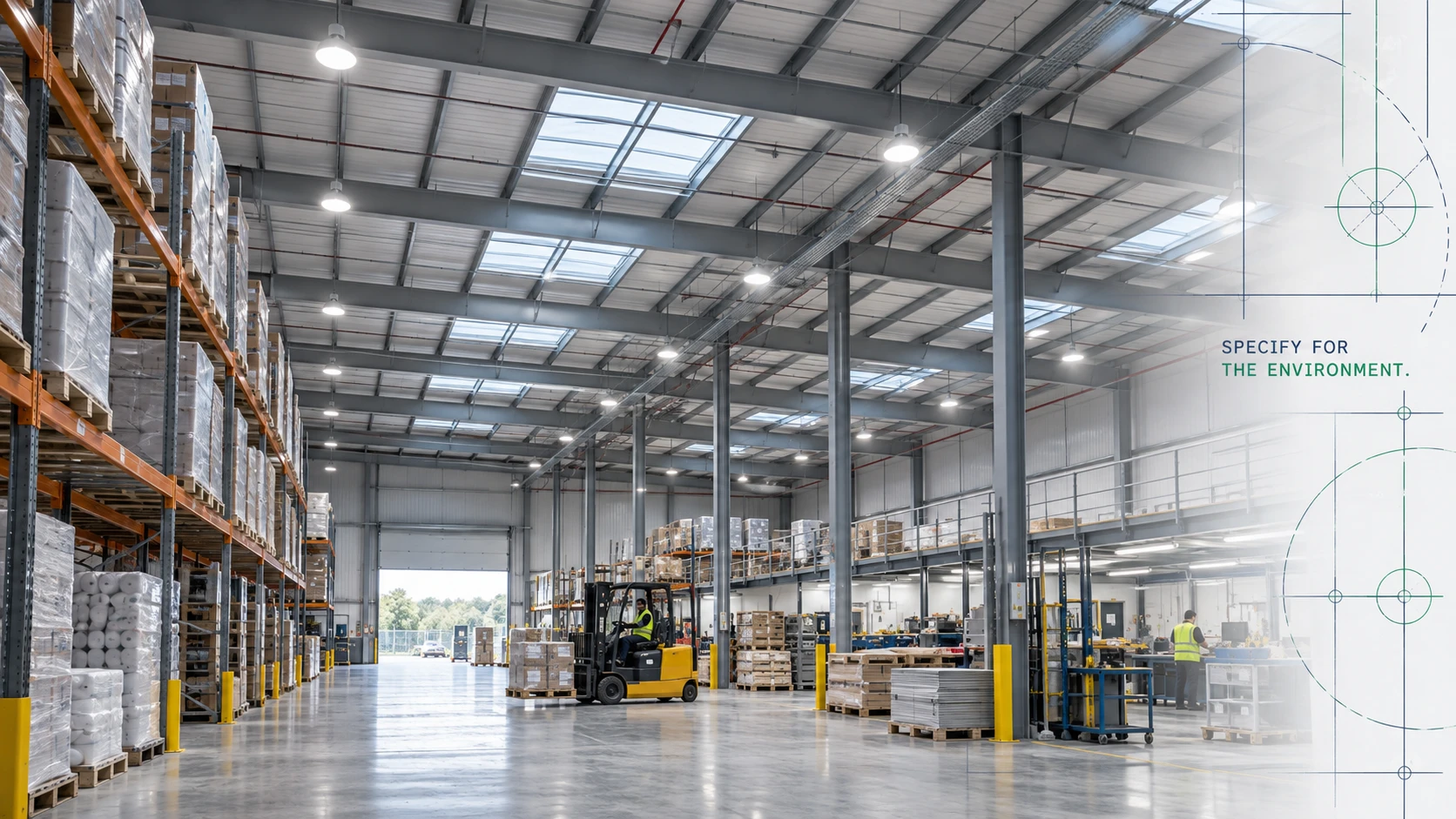
Warehouses and industrial premises may require high-output luminaires designed for greater mounting heights, long operating periods and demanding working conditions.
Exterior commercial areas introduce further considerations including weather protection, suitable IP ratings, visibility, access routes and the relationship between functional and architectural lighting.
A specialist LED lighting supplier in Ireland can help contractors and businesses compare solutions according to the application rather than treating every project as a straightforward lamp-for-lamp replacement.
Think about light quality as well as light quantity
Commercial lighting is ultimately there for people to use.
Two installations can consume similar amounts of energy and produce comparable quantities of light while creating noticeably different environments. Distribution, glare control, colour rendering and colour temperature all influence how comfortable and appropriate a space feels.
This becomes particularly important in customer-facing environments such as shops, hotels, restaurants and reception areas, but it also matters in workplaces where staff may spend many hours under artificial lighting.
The right specification should therefore consider not only how much light is produced, but where that light goes and how it interacts with the people, surfaces and activities within the space.
Do not overlook controls and operating patterns
The efficiency of a lighting installation is determined not only by the fittings themselves but also by how and when they are used.
A meeting room that sits empty for much of the day does not necessarily need to be illuminated continuously. The same principle applies to storage areas, corridors and other intermittently occupied spaces.
Depending on the project, appropriate switching, occupancy sensing, daylight-responsive control or dimming can form part of the overall strategy.
It is therefore worth considering controls during the specification stage rather than treating them as an optional addition after the fittings have already been selected.
Installation conditions matter
A product that performs well in a clean indoor environment may be unsuitable for a damp exterior location or a demanding industrial setting.
For this reason, factors such as ingress protection, mounting method, ambient conditions and physical accessibility need to be considered before installation.
Maintenance should also form part of the decision. In areas with high ceilings or difficult access, changing a fitting can involve considerably more than the cost of the replacement product itself. Access equipment, labour and disruption to normal operations can all add to the real maintenance cost.
For commercial projects, reliability and appropriate specification can therefore have considerable practical value over the lifetime of an installation.
Consider the project as a system
Modern commercial projects increasingly use several forms of lighting within the same building.
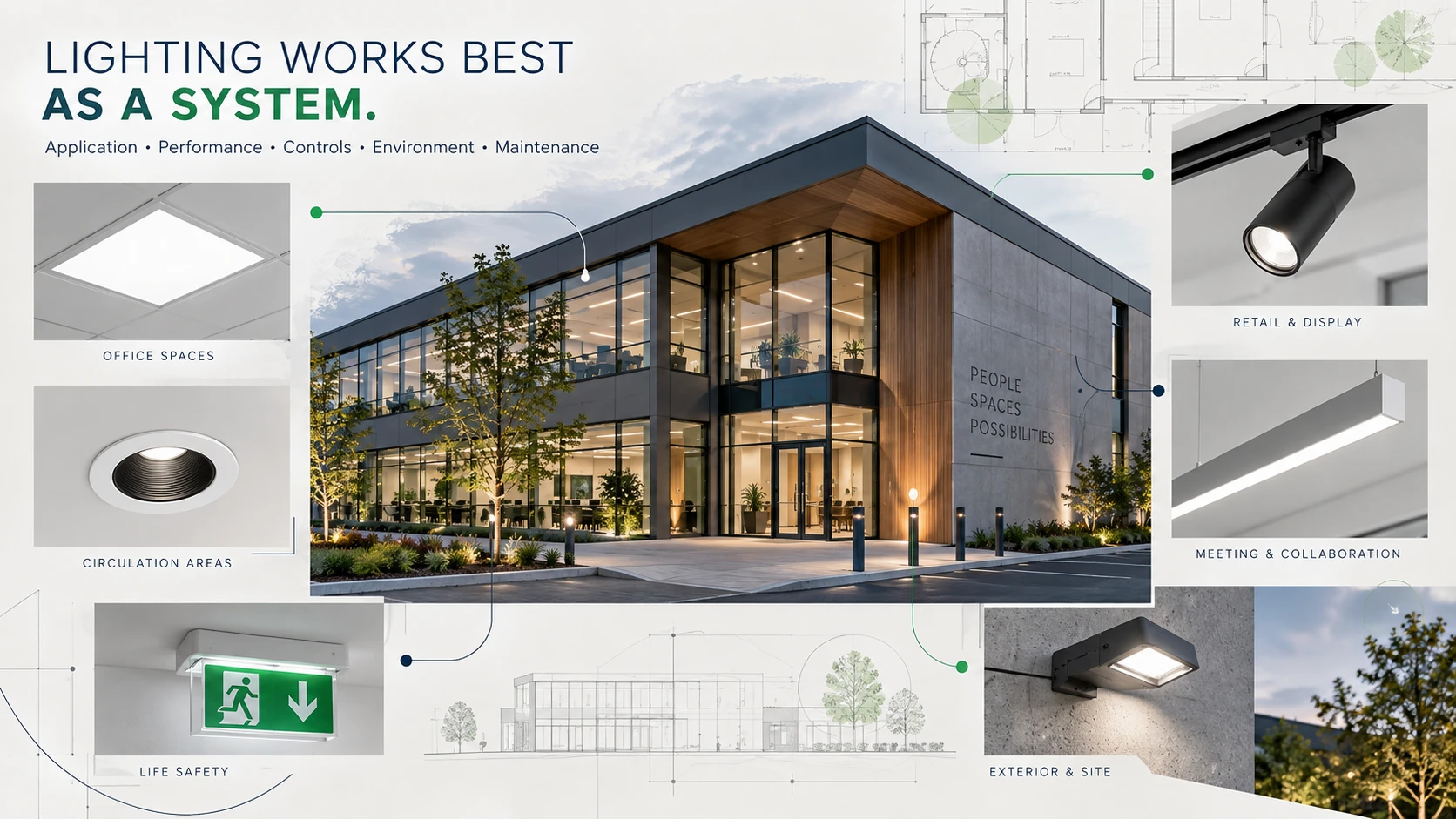
An office development, for example, might combine panels or linear luminaires in working areas, downlights in circulation spaces, emergency lighting, exterior fittings and architectural lighting in reception or customer-facing areas.
Rather than sourcing each element independently, considering them as part of one coordinated specification can make it easier to maintain consistency in appearance, colour temperature, controls and installation requirements.
Ranges of commercial LED lighting now cover applications ranging from offices and retail environments to hospitality spaces, warehouses and exterior areas, giving contractors and businesses considerably more flexibility when developing a project-wide solution.
Plan for the building you will be using tomorrow
A lighting upgrade is generally expected to remain in place for years, so the specification should not focus exclusively on today’s layout.
Commercial premises change. Retail displays move, offices are reconfigured, tenants change and businesses expand. Where future flexibility is likely to matter, the lighting design should take that possibility into account.
Track systems, modular solutions and carefully planned lighting zones can offer more adaptability than a layout designed around one fixed arrangement.
This does not mean every project requires a complex lighting system. It means that the expected life and future use of the building should form part of the initial conversation.
A better LED upgrade starts with better questions
The strongest commercial lighting projects are not necessarily those with the greatest number of fittings or the most elaborate technology. They are the projects where the lighting has been selected for the actual requirements of the space.
For Irish businesses planning an LED upgrade, that means looking beyond purchase price and wattage. Energy use, light quality, distribution, operating hours, controls, environmental conditions, maintenance and future flexibility all deserve consideration.
Approaching the project this way turns an LED upgrade from a simple product replacement into a considered investment in how the building operates and how people experience the space.