
20 November 2026
By Roger Kennedy
roger@TheCork.ie
When Winter Arrives Late, Cross-Country Skiers Change the Plan
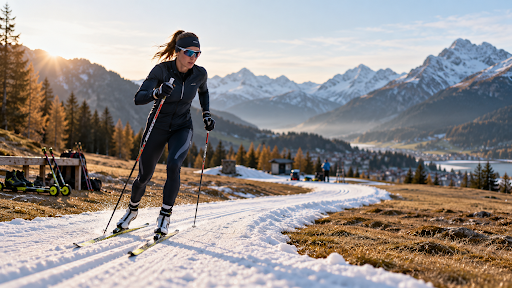
Davos is scheduled to open a four-kilometer cross-country track on October 30, 2026, using snow saved from the previous winter. The Swiss resort preserves a large pile beneath sawdust throughout the summer, allowing athletes to begin skiing before natural snowfall provides dependable coverage. It is one response to a problem facing professional cross-country skiers: training schedules still demand technical work on snow, even when autumn temperatures refuse to cooperate. Roller skis, treadmills, and carefully timed snow camps now sit alongside traditional winter preparation. Coaches must decide which sessions can move onto dry land and which still require actual skis on snow.
Davos Has Been Saving Snow for 15 Years
The Davos operation began as an experiment more than 15 years ago. Its current system stores approximately 20,000 cubic meters of snow under insulating sawdust, preserving an estimated 70–80% of the original volume over summer. At the end of October, the remaining snow is spread along the Flüela Pass road to create an early-season training track.
Four kilometers is enough for repeated technique sessions and controlled efforts, although athletes cannot reproduce every race-course feature on one short loop. Long climbs, changing descents, and different snow textures still require other venues. Stored snow gives coaches a predictable starting point for technical preparation rather than a complete substitute for winter mountain conditions.
The Roller-Ski Session Has Become More Valuable
Roller skiing has been part of cross-country preparation for decades. FIS formally recognized it as a separate discipline in 1992, and international competitions now provide opportunities for athletes to test speed and technique away from snow.
During summer 2025, Italian skier Federica Cassol shared training footage involving roller skiing, lactate checks, and sprint preparation ahead of the Milano Cortina Olympic season. Spanish athlete Jaume Pueyo also participated in roller-ski sprint competitions at Font-Romeu.
Classic and skating roller skis reproduce different movement patterns, while paved climbs allow coaches to target specific training intensities. Wheels do not slide or grip exactly as skis do on snow, however, so athletes must readjust their technique when they return to winter equipment.
Recovery Hours Have Their Own Routine
A professional skier’s training day rarely finishes with the final interval. Coaches still review heart-rate data, lactate measurements, and session quality, while athletes prepare for the following day’s workload.
Digital entertainment may occupy some of their personal downtime. Adults familiar with live casino bd content may recognize streamed roulette, blackjack, and other live-dealer games, where presenters manage the action in real time. Roulette follows a fixed wheel structure, whereas blackjack involves decisions governed by the cards dealt and the table’s rules. These games represent a separate form of leisure in markets where the services are permitted. For competitive skiers, sleep, nutrition, and the following training session remain priorities when organizing recovery time.
Treadmills Put the Climb Under a Coach’s Control
Outdoor roller-ski sessions depend on traffic, road surfaces, and weather. A large motorized treadmill offers another option: the athlete can repeat an uphill effort at a selected speed and gradient while a coach observes technique.
Canadian skier Sonjaa Schmidt appeared in a roller-ski treadmill interval session documented by FIS in August 2025. The federation’s coverage also showed German skier Coletta Rydzek combining uphill running and roller skiing during a training camp in Goms, Switzerland.
Treadmills make repeated testing easier because speed and incline can be reproduced between sessions. They cannot recreate an entire World Cup course, where cornering, changing gradients, and interactions with competitors affect race execution.
Equipment Testing Still Needs Real Snow
A pair of racing skis that glides beautifully on cold, dry snow may be a poor choice when temperatures rise towards freezing. Technicians have to consider the base structure, wax, moisture, and snow crystals before selecting equipment. Roller skis tell them little about any of those things, no matter how closely an athlete’s movements resemble skiing.
The importance of understanding technical specifications extends beyond sport. Adults comparing options under best online casino in Bangladesh may look at RTP percentages, game volatility, and the rules used at live-dealer tables. Each describes a different aspect of a casino game, helping players distinguish between formats rather than judging them on appearance alone. Ski technicians make their own comparisons under very different conditions, often testing several pairs on the same stretch of snow before a competition. A ski that feels quick during one test still needs checking when the weather changes overnight.
Four Kilometers of Snow, Plenty of Work to Do
The first sessions back on snow are particularly useful for spotting habits developed during months on roller skis. A skating athlete may need to adjust the timing of a push, while a classic specialist has to rediscover how the ski grips during the kick phase. Coaches can watch those movements on Davos’s prepared track and make corrections before the winter racing schedule begins.
FIS’s 2025 summer training coverage showed Benjamin Moser working on strength and the Weng sisters cycling, part of the broader preparation that continues away from snow. Neither activity replaces the feel of skis running across a changing surface.
Davos plans to open its four-kilometer snow-farming loop on October 30, 2026. Teams arriving for the first training block can use it for technique drills, controlled intervals, and comparing equipment, rather than trying to recreate a long-distance race on the same short circuit. Longer endurance sessions can remain on roller skis or other suitable terrain until additional snow arrives. The opening date gives coaches something concrete to plan around; the weather will decide how quickly their options expand.