
29 November 2026
By Elaine Murphy
elaine@TheCork.ie
Billy Kelleher MEP spoke at today’s annual Kilmichael Ambush Commemoration
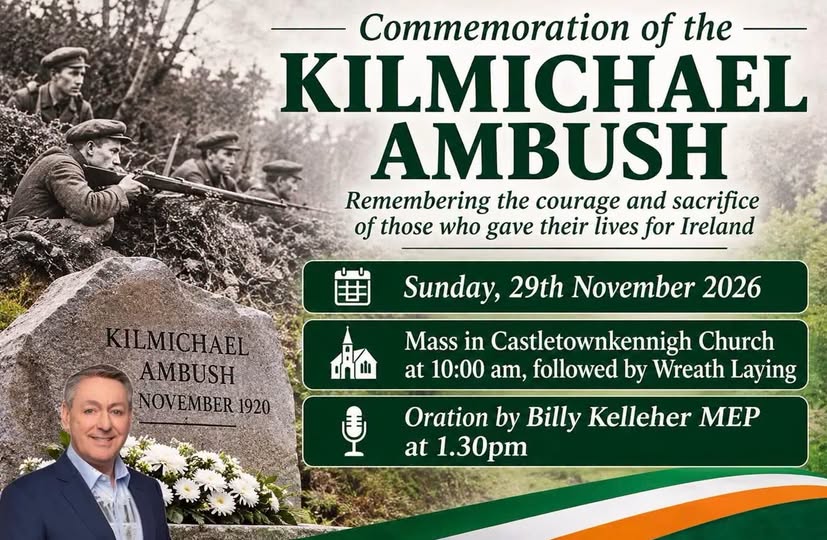
The Kilmichael ambush was an attack carried out on 28 November 1920 by the IRA near the village of Kilmichael, County Cork, during the Irish War of Independence. Some 36 local IRA volunteers commanded by Tom Barry killed sixteen members of the Royal Irish Constabulary’s Auxiliary Division. The Kilmichael ambush was politically as well as militarily significant. It occurred one week after Bloody Sunday and marked an escalation in the IRA’s campaign.
Speech delivered by Billy Kelleher MEP (Fianna Fail)

A chairde uaisle, go léir,
Distinguished guests, Ministers, TDs, Senators, Councillors, members of the Kilmichael Commemoration Committee, ladies and gentlemen.
It is a distinct privilege and honour for me to stand here today in Kilmichael, at this historic and revered sit, to remember the men who took part in one of the defining engagements of Ireland’s Fight for Freedom.
We gather to remember the events of 28 November 1920. We gather to honour the men who fought here, and those who lost their lives.
We also gather to remember our country’s revolutionary generation—men and women, mainly in their 20s and 30s—who did the unimaginable, brought the British Empire to its knees and won the 26 counties its freedom and independence.
We gather, too, to remember the families, the communities and the ordinary people of West Cork who supported that struggle, often at enormous personal cost.
And we gather because remembering the past matters. It matters that we understand where we came from.
It matters that we recognise the courage, determination and conviction of those who came before us.
And it matters that we consider what their example asks of us today.
Because the most meaningful way to honour that heroic generation is not simply to remember what they did, but to reflect on what we must do with the opportunities and freedoms that their sacrifices helped to secure.
Kilmichael – a defining moment in our history
On that November day in 1920, a column of Irish Volunteers, led by Tom Barry, engaged a force of the Auxiliary Division of the Royal Irish Constabulary on this stretch of road.It was a defining moment in the War of Independence.
Just one week earlier, the nation had been shaken by the bloodshed of Bloody Sunday in Dublin – the unforgivable and inhumane slaughter of innocent people attending a Gaelic Football match.
Across the country, people lived under the shadow of curfews, and reprisals by the Crown’s Auxiliary Division.
Yet, out of these West Cork hills stepped ordinary men—farmers, labourers, clerks, and students—who refused to accept Imperial Oppression as their future.
Three Irish Volunteers lost their lives: Michael McCarthy, James O’Sullivan and Patrick Deasy.
We remember their courage, and the sacrifice they made. They were not driven by hatred, nor by a grá for violence.
They were driven by a deep, unshakeable belief in the right of the Irish people to determine their own destiny, free from coercion and division.
Seventeen members of the Auxiliary force also died that day.
One hundred and six years later, we should be generous and confident enough to remember them.
We are not here to rejoice in their deaths but to commemorate this defining battle and remember those who lost their lives.
The events of that day sent a profound message throughout Ireland and beyond.
They demonstrated that the struggle for Irish independence was not going to be extinguished by intimidation, repression or the deployment of overwhelming military resources.
Like all revolutions, the War of Independence rejected the status quo.
A belief that something different, something better could be created. Kilmichael became a symbol of resistance and determination.
But we should never reduce the significance of this place to a military engagement or a tactical victory.
Behind every name was a person. Behind every Volunteer was a family.
Behind every decision to take part in the struggle was a personal sacrifice and a willingness to accept consequences that could be devastating.
These were young men.They had families, friends, ambitions and hopes for their own futures. That is the sacrifice we remember.
We should also recognise the women who sustained the independence movement.
Members of Cumann na mBan, local women and countless unnamed individuals provided intelligence, shelter, medical assistance, communications and practical support.
Their contribution was indispensable, even if history has not always given them the rightful recognition they deserved.
The struggle for independence was never the work of one individual or one military column.
It was a national movement, sustained by communities across the country.
And West Cork, as we all know, played a remarkable role in that story.
The sacrifice of a generation
When we look back at the generation that fought for Irish independence, we must remember the extraordinary circumstances in which they lived.Ireland was a country seeking to emerge from centuries of political subordination.
Democratic aspirations had been frustrated.
Political representation had failed to deliver the national self-determination sought by so many.
The men and women of that generation believed that Ireland should be free to make its own decisions, shape its own institutions and determine its own future.
They wanted an Ireland in which the people of this country would be masters of their own destiny.
Their sacrifices were not confined to the battlefield.Families endured raids on their homes.
Parents who feared for their sons and daughters.
There were communities subjected to intimidation and reprisals.
There were people who lost their livelihoods, their security and, in some cases, their lives.
The consequences of the struggle reached far beyond those who carried arms. And we should remember that the revolutionary generation did not all agree on the path that Ireland should take.
The Treaty, the Civil War and the divisions that followed demonstrated that achieving independence did not automatically resolve the profound questions facing our country.
We should remember those divisions, too. We must be honest about our history, including its complexity, its contradictions and its human cost.
But we should never lose sight of the extraordinary courage of those who believed that Ireland could and should have a better future.
Their generation gave us the foundations of an independent democratic state. It is our responsibility to use the freedom they helped secure wisely and responsibly.
The responsibility of our generation
A chairde, we live in a very different Ireland today. We are a sovereign democratic republic. We are proud and respected members of the European Union.We have developed strong democratic institutions, a successful economy and a modern society.
We have enjoyed decades of peace and prosperity that would have been difficult for that revolutionary generation to imagine.
But our national story remains unfinished. The aspiration for Irish unity is why I’m in active politics.
It shaped my choices as a young man and reminds me that big picture thinking is as important as day to day governing.
It is an aspiration shared by many people across this island, and one that deserves serious, thoughtful and respectful consideration.
Recent developments on this issue by Fianna Fáil and Fine Gael show me that the question now facing our generation is not simply whether we want a united Ireland, but how we will get there and what it will look like.
Today, we have an opportunity to pursue that unity through democratic means, through the full implementation of the Good Friday Agreement, through dialogue, and through consent.
That is a profound difference between their generation and ours.
We do not need to take up arms to advance the cause of Irish unity.
We have democratic institutions, constitutional arrangements and an international framework that provides a peaceful and legitimate route forward.
The Good Friday Agreement established the principle that the constitutional future of Northern Ireland must be determined by the democratic wishes of its people.
Our own Constitution, in Article 3, expresses the aspiration to unite the people who share this island, in all the diversity of their identities and traditions.
However, it makes clear that this must happen by peaceful means and with the consent of a majority of the people, democratically expressed in both jurisdictions.
That is the constitutional and democratic framework within which all of us must operate.
But it works both ways.
Those who oppose Irish Unity must accept that if a majority of people of this island vote for unity, then Irish Unity must happen.
Parity of esteem goes both ways.
And we should protect and defend that principle of parity of esteem.
In a future United Ireland, we must also not repeat the mistakes of the past where a minority in the North were discriminated against and treated like second-class citizens by the majority.
A united Ireland built on consent
A united Ireland cannot simply be about erasing the border on a map. It must be about bringing people together.People who have, for centuries, thought of each other as enemies and not as fellow Irish people.
It must be about creating a country in which people from every tradition, background and identity can feel that they belong, that their rights are protected and that their voices are heard.
If we are serious about Irish unity, we must be serious about the concerns of unionists and the British identity of many people in Northern Ireland.
We cannot expect people to embrace a shared future if they believe that their identity, culture or traditions will be diminished in that future.
I want unionists and loyalists to still call this place their home when unity occurs.
Equally, those of us who believe in Irish unity have every right to make our case, to explain our vision and to argue that the island’s future would be better served by closer political, economic and social integration.
But we must make that case through persuasion rather than pressure.
Through engagement rather than confrontation. Through respect rather than division. And ultimately, through democratic consent.
The peace we enjoy today was hard won. It was achieved through political courage, compromise, difficult conversations and the willingness of people to move beyond the divisions of the past.
It required leadership from people who understood that peace was not an abandonment of their principles, but a different and more effective way of pursuing a better future.
We owe a tremendous debt of gratitude to all those who made that possible.
People like John Hume, Albert Reynolds, Gerry Adams, Seamus Mallon, Bertie Ahern, Tony Blair, John Major, David Trimble and Martin McGuinness.
They all took a step into the unknown to make a better future for all of us. But peace must be protected.
The pursuit of Irish unity must never undermine the peace process.
It must strengthen it.
Friends, I firmly believe that when Irish Unity occurs, it will require all of us to be brave and to be courageous, and like those who fought in our War of Independence, to be open to the idea of something new – something different.
We must demonstrate that a new Ireland would be a place of opportunity, fairness and belonging for everyone.
That is the challenge facing those of us who advocate constitutional change.
We need to have the difficult conversations now, not postpone them until the prospect of a referendum becomes more immediate.
We need to discuss public services, healthcare, education, taxation, pensions, infrastructure, economic development and the practical arrangements of government.
We need to listen to people who have concerns, including those who may never have considered themselves part of the Irish nation.
And we need to be confident enough in our vision to welcome scrutiny and debate. We must be generous in our discussions and negotiations.
We must remind ourselves of the bigger picture every time we engage with the unionist community.
A united Ireland must be something that people choose because they believe it offers a better future.
It must be built on a foundation of mutual respect and shared opportunity.
That is how we give real meaning to the democratic aspirations of the generation we remember here today.
This will require those of us with a pro-unity point of view to ask ourselves, ‘what are we willing to sacrifice to make a United Ireland a reality?’
Questions surrounding flags, anthems, and the constitutional architecture will all be asked.Every single one of us who will advocate for a united Ireland will be asked these questions. Will we be brave enough to answer
The Ireland we want to build
There is another lesson from the generation of 1920 that deserves our attention.They were not simply fighting against something. They were fighting for something.
Unlike many of the other nationalist revolutions in Europe, in the early part of the 20th century, the Irish struggle for freedom was an open and internationalist endeavour.
They wanted a country in which people could live with dignity, where opportunity was not determined by privilege, and where the people of Ireland could shape their own destiny.
The Ireland of today has achieved much. We have built one of Europe’s most successful economies.
We have developed a strong international reputation.
We have transformed our society in many ways, creating opportunities for generations of Irish people.
The constant flow of emigration from our island has been halted.
Ireland is now a place completely transformed compared to the 1920s. But we must also acknowledge the challenges that remain.
Too many people struggle to secure affordable housing. Too many families find the cost of living difficult to manage.
Our health service faces significant pressure, and too many people wait too long for treatment. Rural communities are concerned about access to services, transport and the future of local employment.
Young people are asking whether they can afford to build their lives in the communities where they grew up. These are the challenges that should occupy our attention.
If we are to honour those who sacrificed so much for Irish freedom, we must work to create a country worthy of that sacrifice.
National sovereignty is not an end in, and of, itself.
It is a shared responsibility to do better for our people.
The real measure of our independence is not simply the institutions we have established, but what those institutions deliver for our people.
Can we provide a decent home for our citizens? Can we ensure access to quality healthcare? Can we give every child a fair opportunity in life?
Can we protect our rural communities and support our towns and villages?
Can we build an economy that provides opportunity while ensuring that prosperity is shared?
Can we create a society where people feel valued, included and respected?
These are the questions that should guide our political leadership. And these are questions that must inform any serious discussion about the island’s future constitutional arrangements.
We should not simply ask what kind of Ireland we want to inherit. We should ask what kind of Ireland we want to leave to the next generation.
Our place in Europe and the wider world
As a Member of the European Parliament, I am also conscious of the extraordinary transformation that Ireland has experienced through our membership of the European Union.Second only to our decision to fight for our freedom, joining the EEC in 1973 was the most consequential decision the people of Ireland have ever taken.
Our membership of the European project has been an enormously positive development.
It is not contrary to our fight for sovereignty, as some on the left and right would argue; it is in fact complementary to our national sovereignty.
I firmly believe that an independent nation voluntarily sharing its decision make powers is the best example of our country’s sovereignty.
It has given us opportunities to develop our economy, protect and respect our citizens’ rights, strengthen our international relationships and play a meaningful role in shaping the continent.
It has also demonstrated that national identity and international cooperation are not opposing ideas.
We can be proudly Irish and committed Europeans.
We can cherish our history, language, culture and traditions while recognising the benefits of working with others.
A tangible example of this is the Irish language’s official status within the European Union. Who would have thought 100 years ago that such a thing was possible?
That our language would be treated and respected in the same way as French, German or English?
Indeed, one of the most important lessons of modern Europe is that countries can protect their identities and sovereignty while cooperating to address shared challenges.
That lesson has relevance for our own island.
We should be capable of building relationships across communities and traditions, recognising our different histories while identifying the opportunities we share.
Remembering without being imprisoned by the past
Ladies and gentlemen, there is sometimes a tendency to believe that remembering our history means looking backwards.I do not believe that is true. Remembering our history should give us the confidence and the perspective to look forward.
The men who awoke on that faithful morning in November 1920 could not have known what Ireland would look like a century later.
They could not have imagined the Ireland in which we live today.
They could not have anticipated our membership of the European Union, the economic and social transformation of our country, or the peace that has been built across this island.
But they always believed that Ireland could be better.
They believed that the people of this country deserved the right to determine their own future. That belief remains as relevant today as it did back in the 1920s.
However, our shared responsibility now is to ensure that the next chapter of our national story is written differently from the last.
The sacrifices of the past must inspire us, not dictate that future generations repeat them.
We should honour the courage of those who took up arms by ensuring that future generations never have to do so.
We should honour their commitment to self-determination by defending the right of every person on this island to express their democratic wishes freely.
And we should honour their ambition for Ireland by building a country that is more prosperous, more inclusive and more compassionate.
That is not a rejection of our history. It is the fulfilment of our responsibility to it.
A message to the next generation
I want to finish by speaking about the generations who will come after us. My children and my children’s children.The young people of Ireland today inherit a country that is very different from Ireland of 1920.
They have opportunities that their great-grandparents could scarcely have imagined. They can study, work and travel across Europe.
They can participate in democratic life and have their voices heard. They can shape the future of their communities and their country.
But they also inherit responsibilities. They inherit the responsibility to protect our democracy.
They inherit the responsibility to defend the hard-won peace. They inherit the responsibility to challenge injustice and inequality.
And they inherit the responsibility to consider what kind of island they want to live on.
We should encourage them to engage in the discussion about Irish unity with ambition, confidence and an open mind.
We should encourage them to ask difficult questions, challenge assumptions and consider the practical realities of constitutional change.
But above all, we should encourage them to understand that the future of this island must be built through democratic participation and mutual respect.
Our generation has a responsibility to create the conditions for that conversation.
We must not allow the discussion about Ireland’s future to become a source of renewed division.
Instead, it should be an opportunity to bring people together around a shared ambition for better public services, stronger communities, greater economic opportunity and a peaceful future.
A future in which our different identities are respected, and our common interests are recognised.
That is a vision worth working towards.
Conclusion
A chairde, as we stand here today, we remember the three Volunteers who lost their lives at Kilmichael.
We remember Michael McCarthy, James O’Sullivan and Patrick Deasy.
We remember Tom Barry and the men of the West Cork Flying Column.
We remember the wider generation who gave so much in the struggle for Irish independence.
We remember, too, the families who endured loss, the women who sustained the struggle and the communities whose courage and solidarity helped shape the course of Irish history.
Their names and their sacrifices form part of our national story.
But remembrance must mean more than ceremony. It must challenge us to live up to the responsibilities that freedom brings.
The revolutionary generation that fought for the right of Ireland to determine its own destiny.
Our generation has the opportunity to advance the aspiration of Irish unity through peaceful, constitutional and democratic means.
We can build an Ireland that respects every tradition, welcomes every community and offers opportunity to every citizen.
We can demonstrate that the greatest achievement of national independence is not simply the freedom to govern ourselves, but the ability to create a society in which all our people can flourish.
Let us remember the courage of the past.
Let us protect the peace of the present.
And let us work with determination, patience and confidence towards a better future.
May the sacrifice of the generation we commemorate here today inspire us not to repeat the conflicts of the past, but to build the Ireland of the future through consent, reconciliation and democratic purpose.
Ar dheis Dé go raibh anamacha na ndaoine a fuair bás anseo i gCill Mhichíl agus na daoine ar fad a d’íobair a mbeatha ar son saoirse na hÉireann.
Ar aghaidh leis an obair.Ar aghaidh leis na bPoblacht.
Go raibh míle maith agaibh.