
23 November 2026
By Roger Kennedy
roger@TheCork.ie
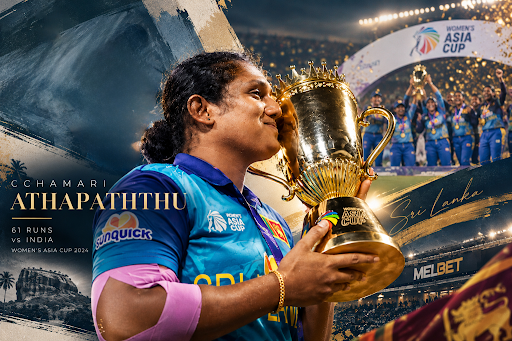
Dambulla, 28 July 2024. Packed stands, humid air and a team that had lost its previous five finals to India. Sri Lanka took to the field burdened by history, whilst their arch-rivals boasted a reputation as seven-time champions – despite there having been only eight previous editions of the tournament. Consequently, the Women’s Asia Cup final seemed set to deliver another victory for the favourites.
Analysts’ pre-match predictions foresaw a defeat for the home side, whilst a cutting-edge online betting app offered generous odds on an underdog victory. Logic suggested that breaking through the Indian bowling line in this decisive cricket clash was unrealistic. But Sri Lankan captain Chamari Atapattu had other ideas, staging a veritable heist in broad daylight on home soil and snatching the much-coveted trophy from the favourites.
India scored 165 but failed to take control
Harmanpreet Kaur won the toss and elected to bat first. The plan worked perfectly at first. In particular, Smriti Mandhana smoothly racked up 60 runs off 47 balls, Jemimah Rodrigues calmly added another 29 to the tally, and Richa Ghosh staged a brief but ferocious final storm on the pitch, scoring a powerful 30 runs from just 14 deliveries. On paper, the final score of 165 for 6 looked impressive. For a final, it was certainly a strong claim to the title. However, in reality, such a solid total never gave India the feeling that they were in control of the situation on the pitch.
Sri Lanka prevented the Indian innings from running higher with a few well-placed strikes through the middle of the order:
- Shafali Verma was dismissed for 16.
- Uma Chetry scored 9.
- Harmanpreet Kaur was limited to 11.
- Kavisha Dilhari finished with 2/36.
India maintained a decent run rate thanks to Mandhana and Ghosh, but never quite reached that psychological threshold. The ‘Lionesses’ avoided that daunting total where any slip-up spells disaster, and retained the right to a couple of relaxed overs. In T20 cricket, the difference between 165 and 185 runs is by no means measured in a mere twenty mathematical points. It is measured by the number of the opposition’s deliveries that the chasing side can afford to simply ignore without resorting to panic mode.
An early run-out did not alter the plan
The chase got off to a rocky start. Vishmi Gunaratne was run out for 1. After five overs, Sri Lanka had scored just 28 runs. The Sri Lankans were biding their time, avoiding rash play and not chasing quick runs. If, at such moments of calm before the storm, you’re looking for the best odds on an underdog’s comeback, it’s worth checking out reliable online betting sites with fast odds updates in advance, as the sixth over alone yielded 16 runs and got the match moving.
Atapattu and Samarawikrama began to build a partnership based on contrast. The captain took more risks, whilst Harshita maintained the structure of the innings. By the middle of the chase, India realised that the early wicket had proved almost inconsequential.
By that point, Atapattu had every reason to play boldly:
- In the group stage, she had scored 119* against Malaysia.
- In the semi-final against Pakistan, she had scored 63.
- Right up until the final, she remained her team’s main source of pace.
She finished the tournament with 304 runs, an average of 101.3 and a strike rate of 146.85. Therefore, her climactic 61 off 43 balls did not seem like an unexpected burst of form. It was the natural culmination of two weeks during which the captain had consistently set the bar higher than usual for Sri Lanka.
61 runs changed the complexion of the chase
Atapattu hit nine fours and two sixes. However, something else was more important. When she was dismissed in the 12th over, the score was 94 for 2. They needed 72 runs from 48 balls. The match could still have been lost, but India were no longer in control of the required rate.
Then Samarawikrama stepped up. Her 69* off 51 balls earned her the Player of the Match award. Kavisha Dilhari added 30* off just 16 balls. The final stretch went without any nerve-wracking calculations based on the run rate table:
- Atapattu scored 61.
- Samaravikrama remained unbeaten on 69.
- Dilhari rounded off the chase with a strike rate of 187.5.
- Sri Lanka reached 167/2 in 18.4 overs.
The hosts won with eight wickets to spare. For India, this defeat was only their second in nine Women’s Asia Cup finals. Incidentally, Bangladesh were the first to stop them in 2018.
This title wasn’t won overnight
The gold in Dambulla marked Sri Lanka’s first-ever Women’s Asian Cup victory. It’s tempting to call this a ‘sudden miracle’, but let’s not be under any illusions. Behind this trophy lay fourteen gruelling months of hard work. First, the girls thrashed England and South Africa in series for the first time in their lives, and then steamrollered their way through the qualifiers for the 2024 T20 World Cup, completely forgetting how to lose.
At the tournament itself, Chomari Atapattu put on a real one-woman show, claiming the title of Player of the Tournament. 304 runs at bat, three wickets in the field – the ICC took note of these figures and awarded her the ICC Women’s Player of the Month for July 2024.
But the final was an ironic affair. The star player who had carried the team to the top was left without the Most Valuable Player award on the most decisive evening of all. The prize went to Harshiti Samarawikrama, who sealed the victory. And you know what? For the champions’ dressing room, this is the best possible scenario. A title is more valuable when it isn’t carried on the shoulders of a single superstar. A victory like this is the result of the coordinated efforts of the whole team, which commands far greater respect.