
3 April 2026
By Elaine Murphy
elaine@TheCork.ie
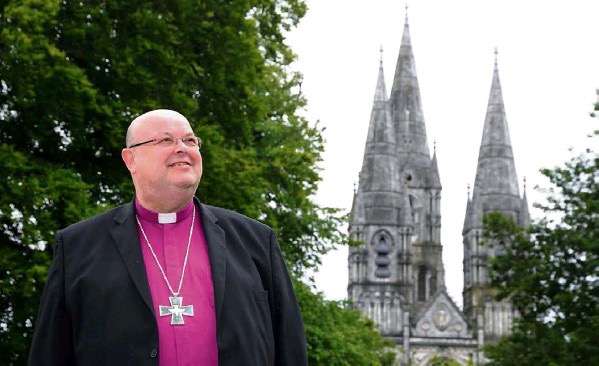
File photo of Bishop Colton
The retirement of the Church of Ireland Bishop of Cork, Cloyne and Ross, the Right Reverend Dr Paul Colton, is approaching quickly. In 2025 he said that his last public service in the diocese would be on Saturday, 18th April 2026, at which time he he will lay down his crozier in Saint Fin Barre’s Cathedral, Cork.
As that date approaches, the Bishop is experiencing a number of “lasts”. In recent days, on Maundy Thursday, the Bishop gave his last sermon to the gathered ministers of Cork, Cloyne and Ross in Rosscarbery Cathedral, West Cork.
Full text of: The Sermon preached by the Right Reverend Dr Paul Colton, Bishop of Cork, Cloyne and Ross at the annual Chrism Eucharist on Maundy Thursday, 2nd April 2026 in the Cathedral Church of Saint Fachtna, Rosscarbery
During the summer Olympics in Tokyo, postponed to the summer of 2021, I was asked to write an article for the annual Journal of the Castlehaven and Myross History Society. I gave my article the title ‘A Love Affair with West Cork.’ In it I asked the question ‘How do you come to love a place as deeply as this, to the point that you feel you yourself belong?’ I hope I answered my own question in that article.
And, incidentally, as an aside, I have always believed that wherever you are in ministry, if you do not come to love the place and the people where you are serving in God’s name, then perhaps you are not in the place God means you to be. It is very basic – Jesus loved the people he moved among, taught and healed – not unquestioningly, not uncritically, not without a prophetic edge, of course. We model our ministry on him, the Good Shepherd, who said ‘I am the good shepherd; I know my sheep and my sheep know me— just as the Father knows me and I know the Father—and I lay down my life for the sheep.’ (John 10.14-15). That profound and sacrificial love of people and place is our calling too.
Bishop William Lyon, the first Protestant bishop of Ross appointed by Queen Elizabeth I in 1582 seems not to have loved this place. He called it ‘the wildest part of Munster.’ He referred to Ireland in general as ‘this barbarous country.’ He became a vigorous and doctrinaire proponent of the Reformation. In fact he advocated the extermination – yes, something, with hindsight, that we must acknowledge and confess in our tradition – the extermination of all Catholic clergy. Fortunately, for whatever reason, the Government of the day did not take his advice, otherwise our shame would be even greater. He wasn’t all bad. Far from it. He did have his good points and was highly regarded by many. There are accounts of 1000s attending his Church Services. He was impressive to many,However, as to Ross (this place) he didn’t think it was good enough for him. He said that it was ‘…in so desolate and barbarous a place as it is not fit…’ for him to live in. All the same, we do have to give him credit for building a cathedral here, as well as a house, a school and a bridge. In a short time he had made a name for himself and so George Goold, the Mayor of Cork, petitioned the famous and zealously Protestant Secretary to the Queen – Sir Francis Walsingham – to have him made the Bishop of Cork a mere two years later. Walsingham was famously known as Queen Elizabeth I’s spymaster. Lots of intrigue in those days – I suppose there’s just as much these days in different ways, especially coming up to an episcopal election! And so it was that Cork, Cloyne and Ross were united for the first time. – temporarily in 1584, and then permanently in 1586. Cork and Cloyne separated again in 1678 and remained separated until 1835, but Cork and Ross have been together in our ecclesiastical setup since the time of William Lyon.Because of both wars and neglect, by the time of the Royal Visitation of these parts in 1615, two years before William Lyon died, the church was in a bad state. Again and again in that report the phrase is repeated ‘church and chancell down’, indicating either the deliberate destruction of the church during, as I say, the wars under Elizabeth I, or simple neglect by the incumbent minister and the parishioners. I hope when you look back, my time as bishop won’t be characterised in that way.However, that was then. Thinking about my own times as bishop, memories of this place was a theme I had addressed, in part, when I came here on 28th May 1999 – five days after Pentecost that year – to be installed as bishop and enthroned. And so it is that I come here once more – one last time as your Bishop in this Diocese – to celebrate with you this, now annual, Chrism Eucharist. Right now my mind is flooded with those same memories and with countless new ones infused in my psyche over the past 27 years. For all of those I thank you. My life, Susan’s life – our family’s life – has been shaped in many ways by this place – particularly the parishes all along this coast, and by you, the people of this place.‘As the Father has sent me, so I send you…’ (John 20.21)That was the last of the three enthronement Sermons I had preached and, in each one, in different ways I had set out the sort of Church I prayed and hoped that we would continue to be and to become. On this day, when we come here each year to renew our commitment to ministry, I thank you for your faithful discipleship, commitment and generosity in being that sort of Church.Today, we heard again the call of God to Samuel and we witnessed Samuel’s readiness to respond: ‘Speak, for your servant is listening.’ (I Samuel 3.10). I am always inspired by part of that story which refers to the lamp in the Temple – ‘The lamp of God had not yet gone out…’ (I Samuel 3.3). There are far too many people, in society and also in the Church, in our time, who, faced with the challenges and changes of these times, have given up and are even minded to think that the ‘lamp of faith’, ‘the lamp of God’ has gone out. I don’t accept that at all and I see , on the contrary, in these times countless ways in which we can be witnesses to the reality that ‘The lamp of God [has] not yet gone out …’ I remember well the first clergy clerical meeting I ever attended. It was in the late 1970s, in the Metropole Hotel in Cork, and I was a potential ordinand. As some clergy often do when they meet, there was moaning. But a priest from this part of the Diocese was having none of it. ‘ You are full of doom and gloom,’ he said ‘but I am full of boom and bloom.’ The way of ‘boom and bloom” has been my preferred approach ever since.Today’s Psalm is a call to unity. And, on this occasion when I preach to all the ministers of the Diocese – lay and ordained – one last time, I thank you for the countless ways in which, in this place, with all our diversity, you have worked to make that togetherness a spiritual and practical reality. In this Service we are reminded, as we heard in the second reading, that God has made us to be a kingdom and priests to serve his God and Father…’ (Revelation 1.6) and our calling is to bring him ‘glory and power for ever and ever!’This ministry of service and proclamation is exemplified in the woman in this afternoon’s Gospel reading – the woman whose name we do not even know, but who gave everything, generously and extravagantly, to Jesus, facing great public scrutiny and criticism for doing so.Even more powerfully, later on in this evening’s Gospel, Jesus will put his money where his mouth has been himself. He will wash their feet:So if I, your Lord and Teacher, have washed your feet, you also ought to wash one another’s feet. For I have set you an example, that you also should do as I have done to you. Very truly, I tell you, servants are not greater than their master, nor are messengers greater than the one who sent them. If you know these things, you are blessed if you do them. (John 13.14-17)As I say, 27 years ago, I took as my text John 20.21 – ‘As the Father has sent me, so I send you…’ – a message, not unconnected to the call we hear today, and the commitment and intent that we are renewing here and now in this Service.And as I developed that theme I asked you all throughout the Diocese to treasure and take seriously the opportunity to be an apostolic Church. These were the characteristics I set out that evening of that catholic apostolicity:I said that the Church is truly apostolic:
- when we all realise that we share this responsibility and mission together. “As the Father has sent me, so I send you…” said Jesus. He sends all of us who have been baptised in his name, who believe in him and who call themselves Christian.
- when the people of God live and work together for the Gospel as a community.
- When we pool and use together, in the words of Saint Paul in his letter to the Corinthians, “…for the common good” the rich variety of gifts which we have been given: when the diversity of gifts is pooled to build up the unity of the Body of Christ.
- when we hand on to others the life-changing stories of Jesus – the good news of his birth, his death, his resurrection, and of the strengthening and energising presence among us today of God the Holy Spirit.
- when the scriptures are faithfully read and freshly interpreted in our times.
- when we say, pray and live the ancient creeds of the Church.
- when the sacraments given to us by Jesus as a means of remembering him and receiving God’s grace are faithfully celebrated.
- when the people of God worship together and express their faith through worship – worship built on the scriptures, made real year by year our living remembrance of the charter events of our faith, and seeking ever to find ways of being relevant to the place and time in which we live.
- when, today through our caring we are sent by Jesus, in partnership with other ministries, disciplines and science, to be the sign and instrument of God’s presence, care and healing.
- when there is care and discipline in the handing on of order and ministry in the life of the Church, when its pattern of ministry and oversight allows orderly and faithful continuity in the handing on of what we have received. In our case, this is a threefold order of bishop, priest and deacon.
- when the people of God seek to challenge and shape society, to confront the local and global issues of the day, when rather than being obsessed with self-preservation it offers itself to the life of the world.
- when with openness and a spirit of tolerant acceptance we seek to hold opposites together.
Quite simply today, I thank you for your faithful response to that challenge and call – not mine, but God’s. Thank you for all you have been and are; and may God bless you all as you journey on.