
26 December 2025
By Elaine Murphy
elaine@TheCork.ie
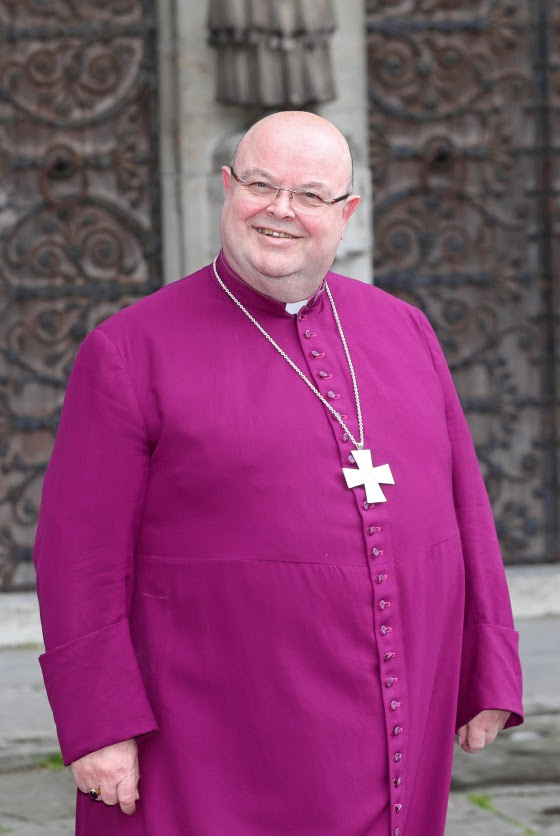
Sermon preached on Christmas Day 2025 in the Cathedral Church of Saint Fin Barre, Cork by The Right Reverend Dr Paul Colton, Church of Ireland Bishop of Cork, Cloyne and Ross
One of Cork’s, or more specifically, Bandon’s famous sons – Graham Norton – hosts a talkshow on BBC and gets about 2.9 million viewers for each episode. I was watching it a few weeks back. One of Graham’s guests that night was the American-French award-winning actor Timothée Chalamet – two academy awards, five Golden Globes, four BAFTA’s and a Grammy. Chalamet was born in 1995 and is considered one of the most talented actors of his generation. I think I first noticed him when he played King Henry V in the film,The King. You’ll all have a chance to see him on RTE One at 6.15 p.m. if you wish, this evening, as he plays Willy, in the film Wonka.
He was on the Graham Norton show because of his latest film, Dune: Part Three which he has just finished filming and which will be released by this time next year in the USA and Canada. Strangely, the conversation turned to Chalamet’s hair because he had lost his long flowing locks of hair (something I became familiar with decades ago). Chalamet revealed that he begged the film director Denis Villeneuve not to cut his hair so short. For the film he had been given a 3 mm haircut but the director wanted it even shorter at 1.5 mm. (When you’ve a head like mine you are very familiar with this sort of terminology, I assure you). Chalamet begged him. He said on the show:
I begged him. I said, ‘Please, please…’ Cause you know…our hair, weirdly we’re all attached. It’s kind of like our personality. These follicles that grow out of our heads.
The great British actress Emma Thompson, was also a guest on the show that night. She suggested he could’ve sold his locks of hair on Ebay. ‘Somebody could’ve stuffed a cushion with them and made a lot of money.’ she suggested. There and then she told him the story of Samson. ’Samson’ she said, ‘your hair contains your power.’
Chalamet looked perplexed. ‘I’ve never heard that,’ he said, ‘I’ve no clue what you are talking about.’ This talented and educated young man had never heard the story of Samson and Delilah – the Israelite strongman who drew his strength from his long Nazirite hair; and Delilah, the Philistine who betrayed him for silver, discovered his secret and had his hair cut. Emma Thompson said she would take him for Margaritas after the show and tell him the story. To hilarious laughter, Graham quipped ‘Margaritas and read the bible to Timothée Chalamet.’
The conversation gave me pause for thought. Not hearing the story, is not the fault of that intelligent and talented young actor; it was someone else’s responsibility to communicate the story and to tell it to him: a salutary tale for all of us in how we pass on the stories of our faith in our homes, in schools and to the world at large. It’s a basic dynamic of communication – if I have a message to convey to you, then the onus is on me to proclaim it so that ‘you get it’, as it were. If you don’t get the message, that’s my challenge. You may lose out but I am the one trying to get the message to you, so that’s my problem, not yours.
Famously, in part of his letter to the Romans, Saint Paul said:
How, then, can they call on the one they have not believed in? And how can they believe in the one of whom they have not heard? And how can they hear without someone preaching to them? (Romans 10.14)
Now, as I approach retirement next year, I can tell you that this was a key and challenging verse (and argument) to me in my own discernment of vocation nearly 50 years ago. So here I am – this is the last of 57 Christmas Day Sermons preached while in office (more than one some years), since I was ordained in 1984. Every Christmas Day sermon was different but essentially, the message was exactly the same each time. Passing on and proclaiming the message is the task of us all – not just the preacher’s – all of us, who take to ourselves the name of Christ, as Christians. We are all called to be messengers of the good news of salvation:
In our first reading, Isaiah refers to that messenger and proclamation. He says:
How beautiful upon the mountains
are the feet of the messenger who announces peace,
who brings good news,
who announces salvation,
who says to Zion, ‘Your God reigns.’ (Isaiah 52.7)
Some might consider Samson and Delilah a niche story in a way that the Christmas story certainly is not. People the world over, regardless of their personal belief, it seems, and their spiritual outlook, celebrate Christmas, in a myriad of ways. And one hopes that in similar countless ways, the core elements of the Christmas Gospel are well known, even if not correctly interpreted, grasped and owned personally. So the onus is on us to keep telling and retelling this story and all the other stories at the heart of our faith.
All too many Christians, in my view, despise society’s jumping on the Christmas band-wagon, in ways that appear utterly unrelated to the simple message and miracle of the baby in the manger – Emmanuel – God with us – the Word of God who lived for a while among us. I take a different view. The continued celebration of Christmas, even with its secular and commercial distortions and excesses, is an enduring opportunity for Christians to proclaim the Christmas good news. If we don’t harness the Zeitgeist we are missing out. My eye turned to a headline in The Times on 19th December in which it was reported that one vicar was packing out the pubs in his parish ‘leading the singing of carols until closing time’ according to the headline. Not such a novel strategy really; after all, many of our carols were written, as our musicians here know, for raucous, rousing singing in all sorts of settings.
The second reading we had today – Hebrews – is a very ancient text. Already in the first century, within about 50 or 60 years of Jesus’ death, it was being quoted, including, in or around 96 A.D., for example, by Clement I, Bishop of Rome. We’re not exactly sure who wrote Hebrews or for whom it was written. Indeed, this is unlike any other letter in the New Testament, because while it finishes up as a letter, it doesn’t start out as one.
But here we are 2000 years later still hearing it at our Christmas liturgy today:
Long ago God spoke to our ancestors in many and various ways by the prophets, but in these last days he has spoken to us by a Son, whom he appointed heir of all things, through whom he also created the worlds. (Hebrews 1.1-2)
For every one of the previous 56 Christmas Sermons when the Hebrews reading was being chosen, I exercised the option given to cut that reading short at just those four verses. It is after all, one of the writer’s main points – the finality of the Gospel of Jesus Christ. ‘Long ago God spoke … but in these last days God has spoken to us by a Son …’ So there you have it! That Son – Jesus Christ – is greater than anyone of God who has gone before, for he is the Son of God. Jesus is God’s ‘final Word’ so to speak. Selecting the readings this year for this 57th Christmas Day sermon, I asked that we go down the optional route, and include up to verse 12 – deliberately – so that we would also hear these words:
And,
‘In the beginning, Lord, you founded the earth,
and the heavens are the work of your hands;
they will perish, but you remain;
they will all wear out like clothing;
like a cloak you will roll them up,
and like clothing they will be changed.
But you are the same,
and your years will never end.’ (Hebrews 1.10-12)
This is actually a quotation from Psalm 102 (verses 25-27). Everything is temporary and passing, but God is eternal. Everything created, including the cosmos, is temporary or subject to change or destruction, but God is unchanging. And now these words are being applied to Jesus. We hear them today so that we can draw faith, hope and love confidently from them on our own journey and in our own situations. And I invite you to do just that as you hear the message of Christmas this year.
Ashton School had its first Christmas Carol Service here in 1973, the year the school was founded. The entire school was marched down from the Blackrock Road. Three of us – 13 year olds – not ideal because our voices hadn’t properly broken – were picked to sing the parts of the Kings in the carol ‘We three kings’. We didn’t distinguish ourselves musically. A total contrast to our own choir and musicians here who, throughout my 27 years as bishop have so enriched and inspired our Christmas celebrations with their music.
Bishop Perdue was the Bishop in those days and the first time I consciously remember hearing the Christmas Gospel was him reading it. By the time Bishop Poyntz became Bishop in 1978, I was in the choir myself and he liked to read the Christmas Gospel from the sanctuary and, in my mind’s eye (and ear) I can still see and hear him holding the Book of Common Prayer aloft – for he read it from that – ‘In the beginning was the Word, and the Word was with God, and the Word was God….’ (John 1.1)
A lot of water has passed under the bridge since. We know this so well in our own experience. The world, society, the Church, every institution in society has changed beyond recognition in the years since. Life and the human predicament have pummelled many people the world over. There have been enormous changes since I first read that Gospel myself as your bishop at Christmas 1999.
But, the essence of our humanity and our human needs and longings have not changed – our need for love, security, companionship, food, quietness of mind, well-being and so much more never change. Most important of all, God has not changed; and the message of the Christmas Gospel has not changed.
And,
‘In the beginning, Lord, you founded the earth,
and the heavens are the work of your hands;
they will perish, but you remain;
they will all wear out like clothing;
like a cloak you will roll them up,
and like clothing they will be changed.
But you are the same,
and your years will never end.’ (Hebrews 1.10-12)
‘And the Word became flesh and lived among us, and we have seen his glory, the glory as of a father’s only son, full of grace and truth.’ (John 1.14)