
19 March 2026
By Tom Collins
tom@TheCork.ie
Practical Matters for People who are Bereaved

Today, Ciara O’Gorman, Development Manager with South Munster Citizens Information Service looks at practical issues that may arise when there is a bereavement. “Bereavement can be overwhelming and it can be a confusing time for people as there are a lot of things to consider. After a bereavement you may need financial support. The Department of Social Protection (DSP) provides certain once-off payments to help out families during this difficult time as well as PRSI and means tested payments.
Support with Funeral Costs
Funeral costs can vary widely depending on what you choose and depending on where you live -city funerals tend to be more expensive than in rural areas. If you need financial support, you may be eligible for an Additional Needs Payment. This is a single payment to help with essential, once-off, exceptional costs (which you could not reasonably cover with your weekly income). This payment is means tested. This means you will have to give information about how much income you have, including savings and insurance policies that the deceased family member may have had to cover funeral costs. You will need to fill in some application forms which you can get download or pick up from your local CIC or social welfare office.
There is a Special Funeral Grant of €850.00 which can be paid if a person dies at work. It is a benefit under the Occupational Injuries Benefit scheme. To be eligible for this grant, the death must have resulted from an accident at work, an accident while travelling directly to or from work or an occupational disease. The person must have paid a minimum of one week’s PRSI. The Bereaved Parent Grant is a once-off payment to widows, widowers, surviving civil partners and surviving cohabitants with dependent children. It is a once off payment of €8,000.00.
What do you need to do if the deceased person was in receipt of a social Welfare payment?

You cannot be expected to do everything right away, but if the deceased was getting a social welfare payment or you were claiming for them as a dependant or you were getting a Carer’s Allowance to look after them, it’s important that you notify the Department within the first few days of the death.
Notifying the Department does not mean the payment will be taken back immediately. In many cases, the spouse, civil partner, cohabitant, parent or carer may continue to receive a payment for six weeks following the death. It will be paid at the same weekly rate your late spouse, civil partner or cohabitant was getting. Examples of social welfare payments that will be paid for 6 weeks include State Pensions Contributory & Non-contributory, Disability Allowance, Invalidity Pension and Carers Allowance/Carers Benefit. Contact your local CIC for a full list of payments.
To qualify, your spouse’s, civil partner’s or cohabitant’s social welfare payment must have included a payment for you (an Increase for a Qualified Adult) or you are getting one of the payments listed above in your own right. In all cases you must inform the Department of Social Protection of the death of the person claiming the payment. To apply for a payment after a death, you should contact the section responsible for the payment within the Department of Social Protection, as soon as possible following the death. Enclose the death certificate (if available) or a death notice from a newspaper with your application. A cheque will be sent to you. Keep your own record of the pension claim or reference number for future reference.
What happens if you are a Carer and the person being cared for dies?
Payment of Carer’s Allowance (full or half-rate) continues to be made for 12 weeks after the death of the person you were caring for. Payment of Carer’s Benefit continues to be made for 6 weeks after the death of the person you were caring for. Domiciliary Care Allowance continues to be paid for 3 months in cases where the child being cared for has died.
Registering a Death
To register a death, you must bring a Death Notification Form stating the cause of death to a civil registration office. You get the Death Notification Form from the doctor who attended the person who died. You must complete Part 2 of the Death Notification Form and take it to the registry office. You will need to bring photo ID with you. The registration is free. You will need some personal details of the person who died, including their PPS number and their parents’ full names.
You should register the death within 3 months of the date the person died. However, you have up to 12 months to register the death. If you need to register a death more than 12 months after the person died, you will need to contact the General Register Office. If you are waiting for an inquest or post-mortem to be carried out, you can get an Interim Certificate of the Fact of Death from the Coroner Service. You can use this to inform institutions like banks, insurance companies and the Department of Social Protection that the death has occurred.
Where do you get a copy of the death certificate?
You can get copies of the death certificate from the registration office when you are registering the death. To get a copy of a death certificate at a later stage, you can go directly to any civil registration office. You do not have to order a death certificate from a service in the area the death took place. You can also apply for a death certificate online, in person at a registry office, by phone or by emailing a completed form to GROonlinepayments@welfare.ie. Civil registration offices have different ways of handling requests for certificates. You can find details about your nearest civil registration office on the HSE website or ask at your local CIC.
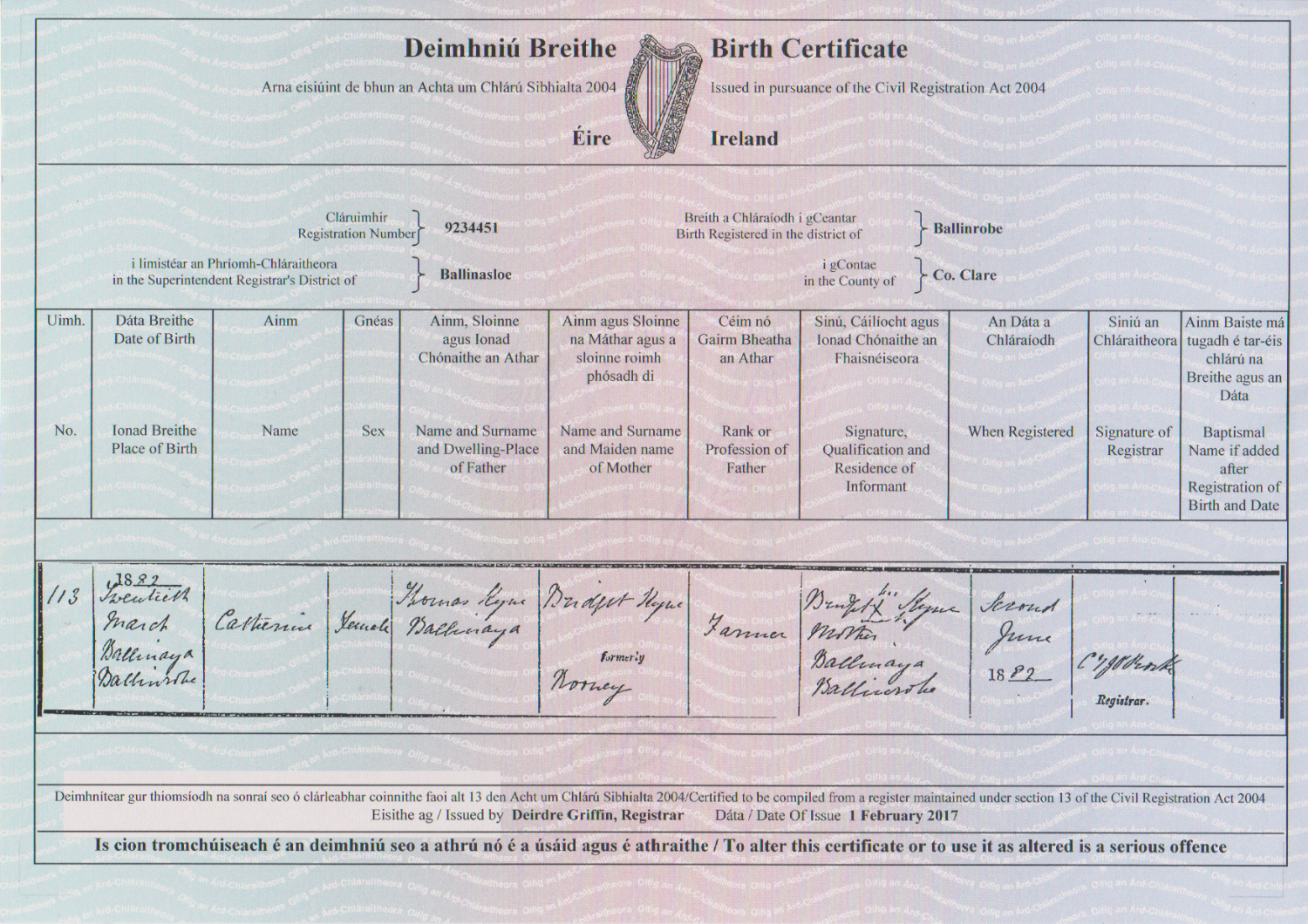
Is there a fee for getting a death certificate?
There is no charge for registering a death. But you may have to pay for a copy of the death certificate. The fees charged for a certificate are as follows:
- €20 for a full standard certificate
- €5 for an uncertified copy of an entry in the Register
- €10 to have a certificate authenticated (only available from the General Register Office)
You do not need to apply for a copy of a death certificate for social welfare purposes, as the Department of Social Protection will have access to this information once the death has been registered.
Changes to the Widows/Widowers Pensions last year.
In July 2025 the Widow’s, Widower’s or Surviving Civil Partners (Contributory) Pension & Widow’s, Widower’s or Surviving Civil Partners (Non-Contributory) Pension were renamed to include cohabitating couple. A cohabiting couple is a couple that lives together in an intimate and committed relationship, who are not married to each other and not in a civil partnership. They are now named the Bereaved Partner’s (Contributory) Pension & Bereaved Partner’s (Non-Contributory) Pension. There were also some changes to the qualifying conditions. You can chat to your local CIC for more information about these changes.
How does one qualify for the Bereaved Partner’s (Contributory) Pension?
To qualify for the Bereaved Partner’s (Contributory) Pension you must be a spouse, civil partner or cohabitant of the deceased. If you are a cohabitant, you must be cohabiting for at least 5 years (or 2 years if you have dependent children together). Either you or your partner must have enough social insurance contributions (PRSI).
All the PRSI requirements must be met on one person’s record – you may not combine the couple’s contributions. All PRSI contributions must have been made before the death of your partner. Virtually all PRSI contributions count towards this pension, including contributions paid by public servants and the self-employed. Contact your local Citizen Information Centre for more information.
Does it make a difference if my partner was getting a State Pension (Contributory)?
You may automatically qualify for a Bereaved Partner’s (Contributory) Pension if your late partner was getting a State Pension (Contributory) which included an increase for you as their adult dependent (or would have included an increase but for the fact that you were getting a State Pension (Non-Contributory), Blind Pension or Carer’s Allowance). There is no automatic qualification if your late partner was getting a mixed insurance pro-rata, EU/Bilateral Agreement pro-rata or Pre-53 pension. In all such cases you should apply in the normal way.
How long is the Bereaved Partner’s (Contributory) Pension paid?
If you re-marry or start to cohabit, the Bereaved Partner’s (Contributory) Pension is no longer payable and you must notify the DSP in writing. If you have dependent children, you can get Child Support Payments (previously called Increases for Qualified Children) with your pension – these remain payable while the child is aged under 18 and they may continue to be paid until age 22 if the child is in full-time education.
Can I claim the Bereaved Persons Contributory Pension if I am employed?
Since this is a contributory pension, you may earn any amount of money from any other source and remain entitled to this pension. It is taxable but if it is your only source of income, you are unlikely to have to pay tax.
What are my options if I do not have enough PRSI to qualify for the Bereaved Partner’s (Contributory) Pension?
If you do not have dependent children, you can apply for the Bereaved Partner’s (Non-Contributory) Pension, which is a means-tested payment. It is paid to a bereaved partner who does not qualify for the PRSI-based Bereaved Partner’s (Contributory) Pension and who does not have dependent children. You must be a spouse, civil partner or cohabitant of the deceased. If you are a cohabitant, you must have been cohabiting for a continuous period of at least 5 years. You must also be aged under 66 (if you are 66 or over, you can apply for the State Pension (Non-Contributory instead). If you re-marry or start to cohabit, your Bereaved Partner’s (Non-Contributory) Pension will no longer be payable.
People with dependent children should apply for the One-Parent Family Payment or Jobseeker’s Transitional payment. You can contact your local Citizens Information Centre for information about the means test and how to apply.
Will I qualify for a Bereaved Partner’s Contributory or Non-Contributory Pension if my relationship had ended?
If you are divorced or your civil partnership was dissolved, and the death of your partner occurred on or after 21 July 2025, you will not get the Bereaved Partner’s (Contributory) Pension or Bereaved Partner’s (Non-Contributory) Pension. If you are separated, annulled or have stopped cohabiting, you will not get either pension if you had lived apart and were not in an intimate and committed relationship for a period of at least 2 years immediately before the date of death of your partner.
How do you apply for the Bereaved Partner’s (Contributory) or (Non-Contributory) Pensions?
You can only apply for these payments by post. To apply, fill in the relevant application form. You can download the form or pick it up from your local social welfare office or Citizens Information Centre.
Help is at Hand
Ciara concludes “As more and more services move on-line, many people feel excluded as they are not comfortable with making applications online for a variety of reasons. In addition, it can be difficult to get to speak to a person as more and more queries have to be submitted by email. Remember, you can contact your local CIC where you can drop-in to meet an Information Office, face to face and get help with sorting your issue. If you need more information in relation to bereavement supports or any other issue, you should call into your local Citizens Information Centre and have a chat with one of our Information Officers. They will go through your situation and guide you in the right direction. The service is free, independent and confidential.”
South Munster Citizens Information
Further information on this and other topics is available from Cork City Centre CIC in Cornmarket Street, open to the public on Mondays, Tuesdays, Thursdays and Fridays from 9.45am to 12.30pm and Wednesdays from 2pm to 4pm, Tel 0818 07 6950 (Lines open Mon-Fri 10am-4.30pm). Blackpool CIC is also open to the public on Tuesdays and Thursdays from 10am to 1pm and 2pm to 4pm, Tel 0818 07 6890 while Hollyhill CIC is open Mondays and Fridays from 10am to 1pm and 2pm to 4pm, Tel: 0818 07 6850.
Information is also available from the Citizens Information Phone Service Tel: 0818 07 4000 (9am – 8pm, Mon – Fri) or online at www.citizensinformation.ie