8 December 2025
By Tom Collins
tom@TheCork.ie
Cork University Press presents:
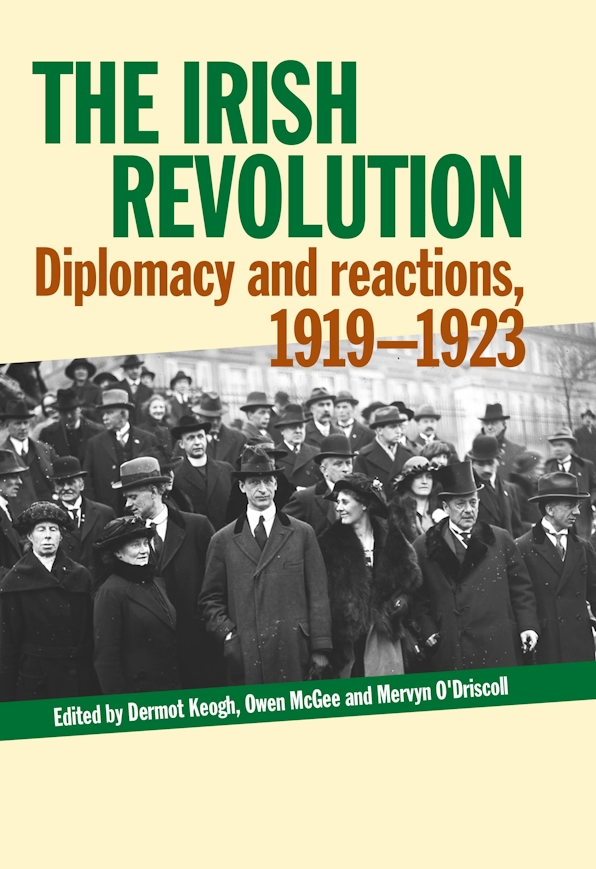
The Irish Revolution
Diplomacy and reactions, 1919-1923
Edited by Dermot Keogh, Owen McGee and Mervyn O’Driscoll
It is often forgotten that leaders of the Irish Revolution considered the domestic and international campaigns for Irish independence to be organically linked. Focusing on this dimension can relocate the Irish struggle in its original and fullest context.
This collection of essays follows the activities of Irish envoys abroad over four years as they defended the right of Dáil Éireann to self-determination and lobbied for its recognition in the capitals of Europe and the British Commonwealth, as well as in the United States. The global impact of Terence MacSwiney’s hunger strike protest is highlighted, as well as the important role played by Catholic networks, diaspora activists and women volunteers.
By reconsidering its international dimension, this book locates the Irish Revolution within an appropriate background of post-war settlements that were not only contested but also remained comparatively fluid. Cultural repercussions of the Irish struggle are also examined at a time of growing international debate about small, emergent states and the existence of contested state boundaries arising from the upending of the old international order caused by the First World War.
Editors:
Professor Dermot Keogh (1945-2023), MRIA, distinguished himself as an Emeritus Professor of History and the Emeritus Jean Monnet Professor of European Integration Studies at University College Cork. His insights into twentieth-century Ireland, European dynamics, and international history garnered him numerous prestigious accolades nationally and internationally. His scholarly contributions are substantial, with over 20 authored and edited books, along with his longstanding role editing Documents on Irish Foreign Policy. Professor Keogh’s expertise, spanning Irish diplomacy, church-state relations, the Jewish experience in Ireland, European integration, and Latin American studies, earned him widespread respect and admiration. His legacy is a testament to his lifelong commitment to advancing understanding in these critical areas of study.
Dr Owen McGee, a graduate of UCD and UCC, is the author of A History of Ireland in International Relations (2020), Arthur Griffith (2015) and The IRB: the Irish Republican Brotherhood from the Land League to Sinn Féin (2005, 2nd ed 2007).
Dr Mervyn O’Driscoll, of the School of History at UCC is the editor of Irish Studies in International Affairs and the author of works such as Ireland, West Germany and the New Europe (2018) and Ireland, Germany and the Nazis (2004, 2017). He co-edited Ireland through European Eyes (2013) and Ireland in the Second World War (2004). He focuses on Irish diplomacy, foreign affairs, Irish-European relations, and nuclear proliferation.
Praise
A major contribution to our understanding of the revolutionary period, offering fresh insights into many under-explored aspects of the time. A fitting final contribution to the legacy of the late Dermot Keogh. ~David McCullagh, Journalist, RTE and author of From Crown to Harp (2025)
This impressive and timely collection offers an astute analysis of the long underappreciated international dimension of the turbulent period of 1919 to 1923 in Irish history. With its wide geographical range, focusing on Europe, the United States and the Irish diaspora within the British Empire, the book is essential reading for anyone interested in the global repercussions of Ireland’s “Greater War” experience, international relations in an age of revolutionary nation-building, and modern European history. ~Robert Gerwarth, Professor of Modern History, UCD
Table of Contents
Introduction
Part One: Ireland, France & America
France and the Irish Revolution, 1919-1923: Estranged republics
Christophe Gillissen
Irish-American relations during the Irish Revolution
Owen McGee
Enquiries of a commercial nature: Leopold Kerney’s activity as an Irish trade envoy in France
Barry Whelan
The international activities of Irish revolutionary women, 1916-1923
Ann Marie O’Brien
Part Two: Ireland and the British Empire
Promoting the Irish Republic at the heart of the British Empire: the propaganda campaign in England and Wales, 1919-1923
Mary MacDiarmada
Sinn Féin’s South African odyssey
Donal P. McCracken
Australia and the Irish Revolution
Jeff Kildea
The “Sinn Féins” of New Zealand’s Press and William Massey’s Governments
Peter Kuch
‘How could you or I die better?’: John T. MacSwiney and fellow Irish political conscientious objectors in Canada, 1918
Pádraig Ó Siadhail
Part Three: Central Europe, Italy & Russia
Spies, Scoundrels, and Secret Diplomacy: the Origins of the Berlin Mission, 1920-21
Mervyn O’Driscoll
Donal Hales: Irish Commercial and Consular Envoy in Italy
Dermot Keogh
Austria-Hungary, the new Austria and the Irish Revolution
Jérôme aan de Wiel
The reaction of the press in the Russian Empire to the Easter Rising
Leonid Kudzeevich
The reaction of the Sinn Féin press to the Russian Revolution
Owen McGee
Part Four: The Irish Diaspora & the Religious Dimension
Informal diplomacy: Catholic opinion and Irish lobbying at the Vatican
Dermot Keogh
Sacrifice or suicide? La Croix’s coverage of Terence MacSwiney’s death by hunger strike
Alexandra Maclennan
Masculinity, martyrdom and national sovereignty: the shared histories of Irish nationalism and Zionism
Aidan Beatty
Aonach na nGaedhael: the 1922 World Conference of the Irish Race in context
Owen McGee
Part Five: Impacts and Reactions
‘Let us Learn, Basques’: the Irish Revolution and its impact in the Basque Country
Niall Cullen and Ludger Mees
The reaction in Galicia to the Irish Revolution
Maria Jesus Lorenzo-Modia
Catalan nationalism and the image of the Easter Rising
Enric Ucelay-Da Cal
Ireland and Emsav: assessing the “Irish myth” in Breton nationalism of the early 20th century
Daniel Leach
Zinaida Gippus’ ‘Why’ and Nikolay Gumilyov’s ‘Gondla’: the Russian ‘Silver Age’ response to the Easter Rising 1916
Andrey Mashinyan
Staging the Revolution: Guo Moruo and Terence MacSwiney
Jerusha McCormack
Contributors
Contributors
Jérôme aan de Wiel is lecturer in twentieth-century European History and European Studies at University College Cork. He is the author of the books The Catholic Church in Ireland 1914-1918: war and politics (Dublin: Irish Academic Press, 2003); The Irish Factor 1899-1919: Ireland’s strategic importance for foreign powers (Dublin: Irish Academic Press, 2008); East German Intelligence and Ireland 1949-90: espionage, terrorism and diplomacy (Manchester University Press, 2015) and Ireland’s helping hand to Europe, 1945-1950: combatting hunger from Normandy to Tirana (Budapest: Central European Press, 2021). He was also co-editor of Ireland through European eyes: Western Europe, the EEC and Ireland, 1945-1973 (Cork University Press, 2013).
Aidan Beatty is a lecturer in the history department at Carnegie Mellon University. He is the author of Masculinity and power in Irish nationalism 1884-1938 (London: Palgrave Macmillan, 2016), Private property and the fear of social chaos (Manchester University Press, 2023) and a co-editor of Irish questions and Jewish questions: crossovers in culture (Syracuse University Press, 2018).
Niall Cullen is a researcher at the University of the Basque Country (UPV/EHU) department of Public Law, Historical-Legal Sciences and History of Political Thought. He holds a PhD in Contemporary History from UPV/EHU and is the author of Radical Basque nationalist-Irish republican relations: a history (London & New York: Routledge, 2024)
Christophe Gillissen is professor of Irish studies at the University of Caen, Normandy. In addition to articles and chapters on Irish history, he has written extensively on Franco-Irish relations in Etudes Irlandaises, Nordic Irish Studies, Irish Studies in International Affairs and other journals. He is also editor of Etudes Irlandaises.
Jeff Kildea, a former barrister, is an honorary professor in Irish Studies at the University of New South Wales. In 2014 he was the Keith Cameron Professor of Australian History at University College Dublin. His books include Tearing the fabric: sectarianism in Australia 1910-1925 (Sydney: Citadel Books, 2002), Anzacs and Ireland (Sydney: University of New South Wales Press, 2007) and the two-volume study Hugh Mahon: patriot, pressman, politician (Melbourne: Anchor Books, 2017 and 2020).
Peter Kuch is Emeritus Professor, University of Otago, New Zealand, and an Honorary Visiting Professor at the University of New South Wales, Australia. He is the author of Irish Divorce/Joyce’s Ulysses (New York: Palgrave Macmillan, 2017). He has edited with Lisa Marr New Zealand’s responses to the 1916 Rising (Cork University Press, 2020). He is currently writing a cultural history of the performance of Irish plays in Australia, 1789 to 1920, a chapter of which appears in the Irish Studies Review (2023). Recently, he has contributed a chapter on Katherine Mansfield’s stories to the Routledge Companion to Literature and Class (2023) and has a chapter on Australian performances of Waiting for Godot in a forthcoming volume with Cambridge University Press.
Leonid Kudzeevich is a senior scholar at the State Museum of the Political History of Russia and was a member of the Irish Cultural Centre, Saint Petersburg (2004-2022). His research interests include the lives of prominent Irishmen in Russia during the eighteenth and nineteenth centuries, the history of Russian-Irish relations and the history of Russian masonry and monetary objects.
Daniel Leach holds a doctorate from the University of Melbourne and is unit co-ordinator and eLearning advisor for history and politics at Swinburne Online, Melbourne. He is the author of Fugitive Ireland: European minority nationalists and Irish political asylum, 1937-2008 (Dublin: Four Courts Press, 2009).
María Jesús Lorenzo-Modia is a full professor of English Studies at the Universidade da Coruña, Spain and a specialist in women’s studies, Irish literature, and comparative studies between Galicia and English-speaking countries. A co-author of The ethics and aesthetics of eco-caring: contemporary debates on ecofeminism (London: Routledge, 2019), she has edited a book on women’s mobility in Galician, Irish and Welsh literature, entitled Ex-sistere (Cambridge Scholars Publishing, 2016); co-edited a monograph entitled Australia and Galicia for the journal Antípodas (2017); and co-edited a monograph on Irish studies for the journal Oceánide (2020). In addition to articles in Boletín Galego de literatura and Estudios Irlandeses, she has recently contributed book chapters to R. Hampton, V. Pauly (eds) The reception of Joseph Conrad in Europe (London: Bloomsbury, 2022), M.E.P. Arronte, C.F. Moreno (eds) British periodicals and Spanish literature (Peter Lang, 2022) and B. Lewandowska-Tomaszczyk, M. Trojszcak (eds.) Concepts, discourses and translations (Springer, 2022).
Jerusha McCormack retired as senior lecturer in the Department of English, University
College Dublin, to teach as for fifteen years as Honourary Professor at the School of
English and International Studies at the Foreign Studies University, Beijing. She has published articles on the relationship with China of Oscar Wilde, James Joyce and W.B. Yeats and edited the works China and the Irish (Dublin: New Island, 2009) and The Irish and China: encounters and exchanges (Dublin: New Island, 2019). She acted as co-author with John Blair of Thinking through China(Lanham, Md: Rowman and Littlefield, 2016) and co-editor with John Blair of Comparing civilizations: China and the West (Shanghai: Fudan University Press, 2018).
Donal McCracken is Emeritus Professor of History at the University of KwaZulu-Natal, South Africa. A founder of the journal South African Irish Studies, his books include Forgotten protest: Ireland and the Anglo-Boer war (Belfast: Ulster Historical Foundation, 2003) and The Irish Pro-Boers 1877-1902 (Johannesburg: Perskor, 1989).
Mary MacDiarmada is a research fellow in the School of History and Geography at Dublin City University (DCU) and author of Art O’Brien and Irish nationalism in London, 1900-1925 (Dublin: Four Courts Press, 2020).
Alexandra Maclennan, a former editor of Etudes Irlandaises, is an associate professor at the University of Caen Normandy and author of Histoire de l’Irlande de 1912 à nos jours (Paris: Tallandier, 2016, 2021). She successfully defended her full Professorship Habilitation in September 2023. She is vice-president of the Société Française d’Etudes Irlandaises (SOFEIR) and the French delegate to the European Federation of Associations and Centres of Irish Studies (EFACIS).
Andrey Mashinyan holds a doctorate in Irish literature from Saint Petersburg State University. He has authored two books of translations of poetry and plays by W.B. Yeats, a book of translations of works by James Joyce and was the principal author of Ирландия: Больше чем остров (Ireland: more than an island), a 2017 volume about Ireland for the Russian-speaking public. He is currently completing a large book on the Celtic Revival for the Russian-speaking public that contains essays and literary translations of Yeats, Lady Gregory and J.M. Synge. Since 2004 he was the director of the Irish Cultural Centre in St Petersburg, which was a member (since 2018) of EFACIS and had academic affiliations with the St. Petersburg State University and Herzen State Pedagogical University of Russia. In October 2022 the centre was officially closed for the time being due to a worsening of Russian-Irish relations.
Ludger Mees, formerly an assistant professor at the University of Bielefeld, Germany, is professor of cotemporary history at the University of the Basque Country, of which he is a former vice-chancellor. He has authored, co-authored or edited seventeen books and many articles and book chapters on the subjects of nationalism, historiography, agrarian history and social movements.
Ann Marie O’Brien, a graduate of the University of Limerick, has taught history at Maynooth University and is the author of The ideal diplomat? Women and Irish foreign affairs, 1946-90 (Dublin: Four Courts Press, 2020). A former editorial assistant with the Documents on Irish Foreign Policy project, she has published articles in the Historical Journal, Irish Historical Studies and Irish Studies in International Affairs.
Pádraig Ó Siadhail is Professor Emeritus at Saint Mary’s University, Halifax, Nova Scotia, Canada. From 1991 to 2022 he was holder of the D’Arcy McGee Chair of Irish Studies and Professor of Irish Studies at Saint Mary’s University. He has published extensively in Irish and English. His books include Stair Dhrámaíocht na Gaeilge, 1900-1970 (Galway: Cló lar-Chonnachta, 1993), a history of Irish-language theatre; An Béaslaíoch (Dublin: Coiscéim, 2007), a biography of Piaras Béaslaí; and Katherine Hughes: a life and a journey(Ontario: Penumbra Press, 2014). At present he is preparing for publication a monograph on the Irish language and South Africa and is working on a study of the Irish-language revival in Canada, 1898-1915.
Enric Ucelay-Da Cal is Emeritus Professor of History at the Universitat Pompeu Fabra and taught for many years at Universitat Autònoma de Barcelona. A graduate of Columbia University, he is a specialist on the history of nationalism in Catalonia and Spain as well as elsewhere and the author of several books, including La Catalunya populista (Barcelona: La Magrana, 1982) and El imperialismo catalán (Barcelona: Edhasa, 2003). Most recently, he published, together with Xavier Casals, El Fascio de las Ramblas: los orígenes catalanes del fascismo español (Barcelona: Pasado & Presente, 2023).
Barry Whelan lectures on Irish and European history at Dublin City University and is the author of Ireland’s revolutionary diplomat: a biography of Leopold Kerney (South Bend: University of Notre Dame Press, 2019).