
12 May 2026
By Mary Bermingham
mary@TheCork.ie
Cork City Council has announced that it has bought the historic Counting House complex on South Main Street which is set to be reborn as the new Cork City Public Library.
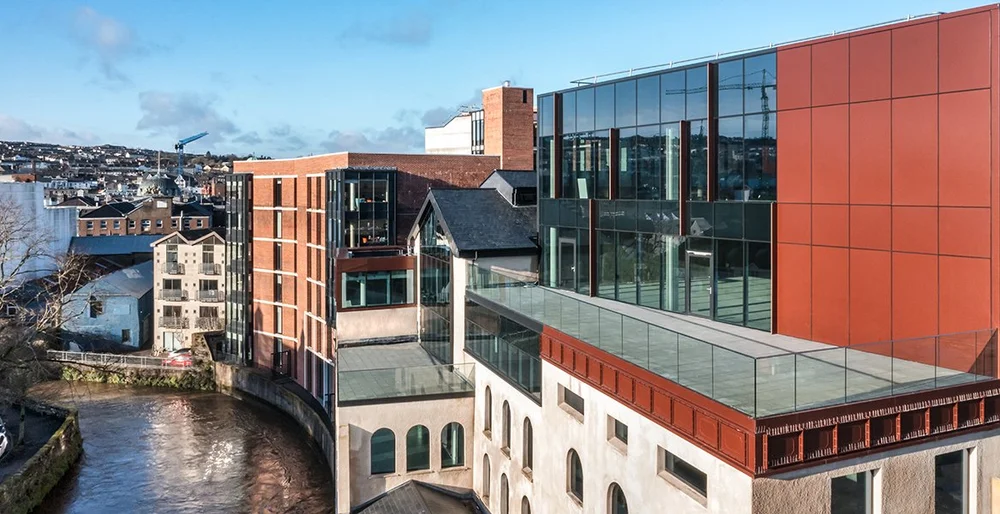
Back of complex from brochure website of Developer. This photo taken before the bridge was built. There is now a bridge linking left (Crosses Green) with right (the complex).
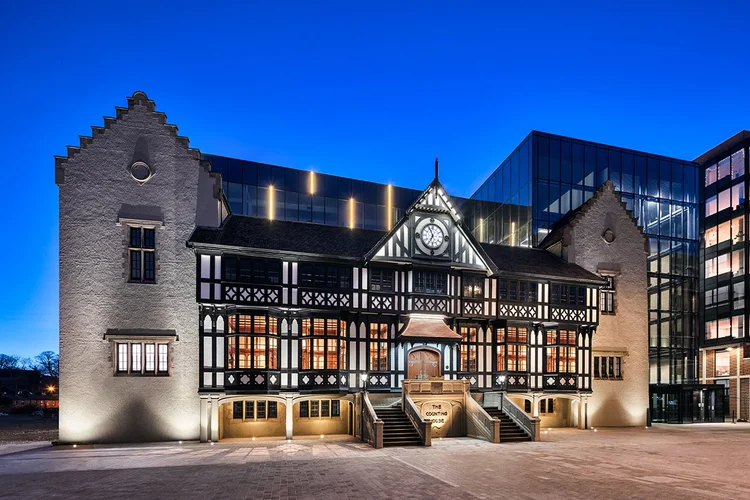
Exterior from brochure website of Developer
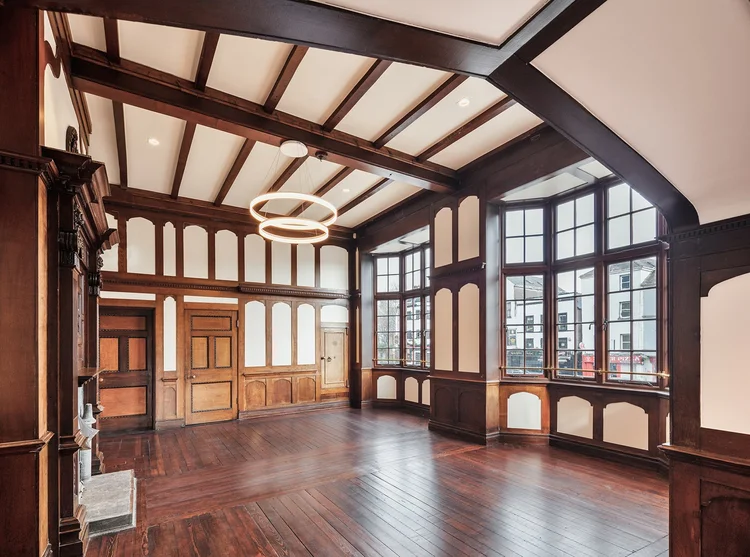
Interior from brochure website of Developer
The €35m (plus VAT) acquisition has been completed with the support of the Department of Housing, Local Government and Heritage and the Government’s Towns and Cities Regeneration Investment Fund (formerly the Urban Regeneration and Development Fund [URDF]). It has been bought from JPDC Ltd, part of the BAM Contractors Limited Group in Ireland.
The former Beamish & Crawford ‘Counting House’ building, which is now being referred to as part of the ‘The Counting House complex‘ was identified as the best location for a new city library following a detailed review, involving local input, national and international experts, of several other city centre options. The complex, which includes the restored landmark Counting House – part of the former Beamish & Crawford brewery – and a four-storey office complex to the rear, emerged as the most affordable, lowest risk, and best performing option across all key criteria, including cost, value for money, deliverability, sustainability, and cultural impact.
It will replace the existing Grand Parade library which is undersized, inflexible, and in poor condition, with issues such as accessibility constraints, and poor energy performance. The modifications needed to accommodate a contemporary library can be done without compromising the history and industrial heritage of the site.
The new library will open to the public much sooner than any of the other options considered. A modern, expanded library to meet current and future demand has been an objective of Cork City Council for some time. This development represents one of the local authority’s largest single investments in cultural infrastructure in a generation.
The Counting House complex extends to just over 83,600 sq ft (just under 7,300 sqm) net internal area, more than three times the size of the current City Library, and will be able to cater for the estimated one million visitors expected to visit the library per annum by 2050.
The reimagined Counting House complex will feature:
a new library with capacity to host the existing 500,000-strong catalogue of books, magazines and journals, up to 1,500 events annually and receive around 300,000 enquiries a year;
300 study spaces;
a new entrance and concourse;
a shop and café space;
lecture, performance and exhibition spaces;
children’s/teen/and young adult sections;
an expanded Cork Local Studies section;
an expanded Rory Gallagher music library.
This adaptive reuse approach will bring a regenerated and vacant building in the medieval heart of the city, and the plaza to the front, into public use in an area undergoing extensive publicly-funded urban regeneration. The plaza will be animated to host concerts and public performances. The Counting House complex was identified as the preferred location for the new city library following a lengthy process which involved national and international library, architectural and engineering experts, and the completion of an updated Preliminary Business Case (PBC) commissioned last year by Cork City Council.
The PBC, undertaken by consultants EY, examined four potential options, under headings including strategic need, options, costs, risks, and economic performance. The options were:
1. Refurbish and extend the existing library premises;
2. Pursue a new-build on the existing Grand Parade site;
3. Pursue a new-build on the riverfront carpark site next to the existing Grand Parade library, which is not in Cork City Council ownership;
4. The adaptive reuse of the Counting House complex.
Option 4, adapting the Counting House complex, emerged as the clear top performer across every major measure. The PBC also found that the adaptive reuse of the Counting House will deliver value for money, offering the lowest capital cost of all options considered, reduced construction and planning risks (because the building already exists), and lower carbon impact and higher sustainability.
A Part 8 planning process will be required to adapt the complex. It will involve consultation. It will also involve detailed design work which will determine the costs associated with the next stage of the project. The strategic development of the Cork City Library service over the next decade has been informed by extensive engagement and consultation with a range of stakeholders, including the Cork City Libraries Service and library users. Engagement with relevant stakeholders will continue as this project evolves.
The Lord Mayor of Cork, Cllr Fergal Dennehy, welcomed the announcement.
“The purchase of this historic building marks an exciting new chapter not just for our library service, but for our city,” the Lord Mayor said.
“Transforming such a landmark into a vibrant public library beautifully honours its past while giving it a meaningful future in the heart of the city centre.
“As this space is reimagined into a modern world-class library, it will become a place of inspiration for generations to come.
“We look forward to seeing the doors open and the building filled with life and learning.”
The Chief Executive of Cork City Council, Valerie O’Sullivan, said the Counting House complex is fronted by a prominent heritage building, the historic character of which makes it a natural home for a flagship cultural institution.
“Its reuse reflects international best practice, where cities such as Helsinki, Aarhus, London and Montreal have transformed historic, industrial or commercial buildings into vibrant, modern libraries that become major civic attractions,” the Chief Executive said.
“The new library will remain in the heart of Cork city centre, reinforcing the area as a vibrant cultural quarter.
“Positioned beside the regenerated Bishop Lucey Park, Triskel Christchurch, the medieval spine and the South Main Street regeneration areas, the Counting House location creates a powerful cultural anchor for residents, students, families and visitors.
“It also unlocks future redevelopment potential at the existing library site, supporting wider renewal that the Council will bring forward for the Grand Parade Quarter.
“It is fitting that this building is now in public ownership to serve the people of Cork and those who come here for generations to come.
“This new world-class facility serves as an attractor of people to our city, a priority objective of this Council.
“I would like to pay tribute to my fantastic team in City Hall who managed this acquisition and to our Department colleagues for their support in making this happen for Cork City.”
Minister James Browne, TD, Minister for Housing, Local Government and Heritage, said he was delighted to welcome the purchase of the Counting House building by Cork City Council.
“The library that this historic building will ultimately house will deliver a landmark cultural facility that strengthens Cork’s civic infrastructure and enhances its reputation as a vibrant, forward-looking city,” the Minister said.
“This purchase marks the final element of just under €47m of Government investment in the Grand Parade Quarter that was promised under the Urban Regeneration and Development Fund Calls 1 and 2.
“The Grand Parade Quarter development as a whole is transformative and will combine with other complementary developments in the area to create a vibrant quarter where culture and learning acts as a catalyst for business and tourism.”
Several architectural and library experts were involved in the advisory process, including Ruairi Finucane, of project architects, Brock-Finucane.
“Transforming the Counting House into the new Cork City Library creates an architecture that bridges eras — preserving the legacy of tradition while shaping spaces for the city’s future generations,” Mr Finucane said.
“This project celebrates Cork’s industrial heritage while redefining the building’s role as a contemporary cultural landmark.
“The layered design introduces new spatial dynamics within the heritage envelope, combining innovation with authenticity. This regeneration project is fundamentally rooted in sustainability and place.”
Annie Hensley, a principal with fjcstudio, a Sydney Australia-based specialist library advisor and the only architectural practice to have won the World Architecture Festival World Building of the Year award twice, was also involved in the process. Ms Hensley said by partnering with fjcstudio, the Cork City Library project will benefit from a practice with a demonstrated leadership in the design of cultural and civic buildings, underpinned by a rigorous and collaborative methodology.
“Through this partnership, the Cork library project will be informed by international best practice while grounded in the specific cultural, environmental, and urban context of Cork,”
she said.