
12 February 2026
By Roger Kennedy
roger@TheCork.ie
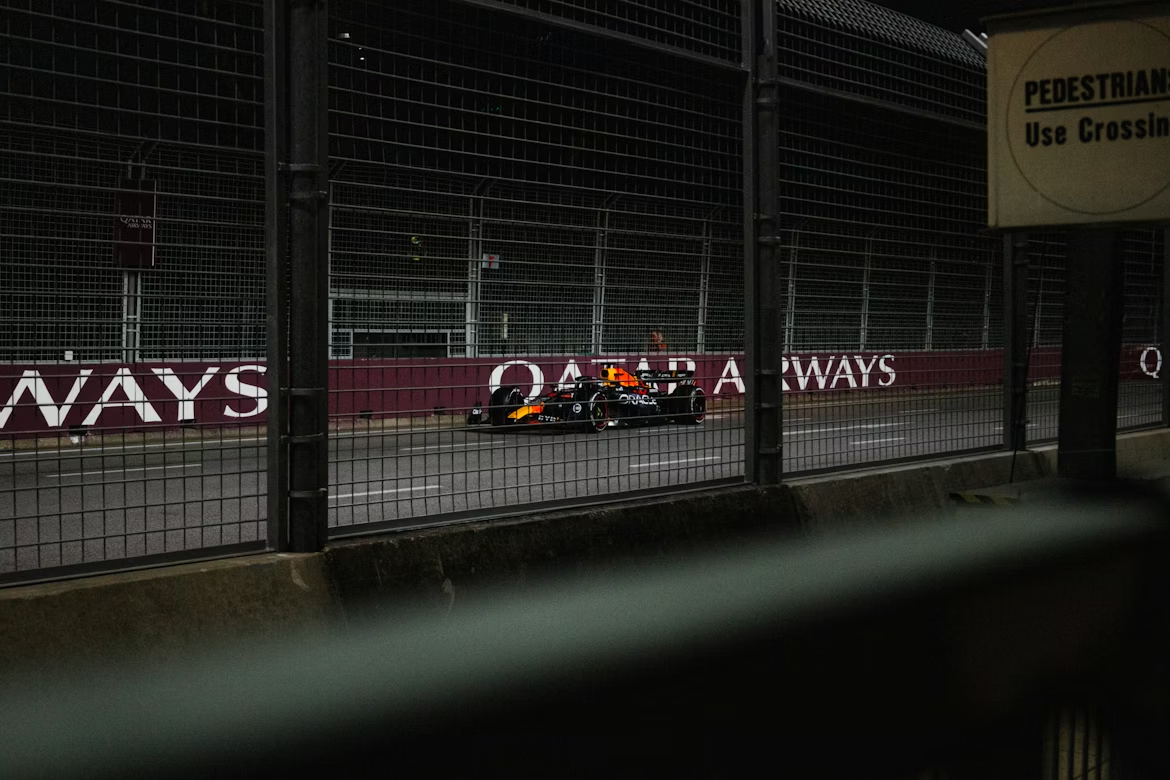
Formula 1 continues to expand its footprint in the United States, attracting new fans through high-profile races and global media coverage.
As interest in F1 grows, so does curiosity about the many betting markets available beyond simply predicting who wins the race. Modern sportsbooks offer a wide range of options that reflect the complexity and structure of a Grand Prix weekend.
From podium finishes to qualifying results and in-race events, F1 betting markets mirror the complexities that shape each race.
Podium Finish (Top 3)
The podium finish market focuses on which driver finishes the race in the top three. Instead of selecting the outright winner, this option centers on whether a competitor secures a podium result. Because F1 races often feature intense competition at the front of the grid, the top-three market provides an alternative to the traditional winner bet.
Sportsbooks list drivers individually, allowing bettors to choose whether a specific competitor finishes first, second, or third. Some platforms also group podium outcomes into combined options. This market reflects how tightly contested the leading positions can be throughout a Grand Prix.
For fans who follow F1 closely, the podium market highlights consistent front-running performances. It captures the importance of reliability, pace, and race-day execution without focusing solely on the overall winner.
Points Finish (Top 10)
The points finish market centers on whether a driver secures a top-ten result in an F1 race. In Formula 1, only the first ten finishers earn championship points, making this an important benchmark across the season. This market reflects that structure by focusing on whether a competitor finishes in those scoring positions.
Sportsbooks typically list drivers individually with “Yes” or “No” options for a points finish. Because the top ten extends beyond the podium, this market covers a broader range of potential outcomes during the race.
Fans exploring markets beyond the race winner often choose this option to reflect overall competitiveness rather than outright victory. Many platforms that allow fans to Bet on F1 racing prominently feature the top-ten market because it connects directly to the sport’s official points system and championship standings.
Head-to-Head (Driver vs. Driver)
The head-to-head market compares two drivers and asks which one finishes higher in the final race classification. This format removes the broader field and focuses solely on the relative performance between a specific pair of competitors.
Sportsbooks often feature compelling narratives of drivers starting near one another on the grid. The outcome of this bet depends only on which of the two crosses the line in the better position, regardless of their overall finishing place in the race.
By isolating two drivers, the head-to-head market provides a simplified way to engage with the competitive dynamics of a Grand Prix.
Qualifying (Pole Position)
Qualifying markets focus on the Saturday session that determines the starting grid for Sunday’s race. The most prominent qualifying bet is pole position, which asks which driver records the fastest lap time in the final qualifying session.
Because grid position significantly shapes race conditions, sportsbooks treat qualifying as a standalone event with its own odds and outcomes. Fans can place wagers specifically on pole position without referencing the eventual race result.
Some platforms also offer markets on whether a driver reaches the final qualifying session or finishes within certain grid positions. These options reflect the layered structure of F1’s elimination-style qualifying format. By separating qualifying from race day, sportsbooks provide fans with more ways to engage throughout the entire Grand Prix weekend.
Fastest Lap
The fastest lap market centers on which driver records the quickest single lap time during the race itself. Unlike the pole position bet, which applies to qualifying, this market applies only to laps completed on race day.
The fastest lap market identifies which driver records the quickest single lap during the race. Sportsbooks list drivers individually, with the outcome based solely on recorded lap time rather than finishing position.
This option highlights the strategic pacing and timing that define race management. Even if a driver doesn’t win, they may still record the fastest lap under certain conditions.
Exploring the Full Spectrum of F1 Markets
Formula 1 betting extends far beyond predicting who takes the checkered flag. From podium finishes and top-ten results to qualifying, fastest laps, and race props, each market reflects a different layer of competition within F1. These options mirror the sport’s technical depth and structured format.
For US fans, understanding these markets enhances appreciation of how a Grand Prix weekend unfolds. Each wager type corresponds to a measurable event within the race calendar.
Understanding the F1 betting markets isn’t everything; however, it does enhance the thrill of watching drivers and machines being tested to the limit.