6 June 2026
By Mary Bermingham
mary@TheCork.ie
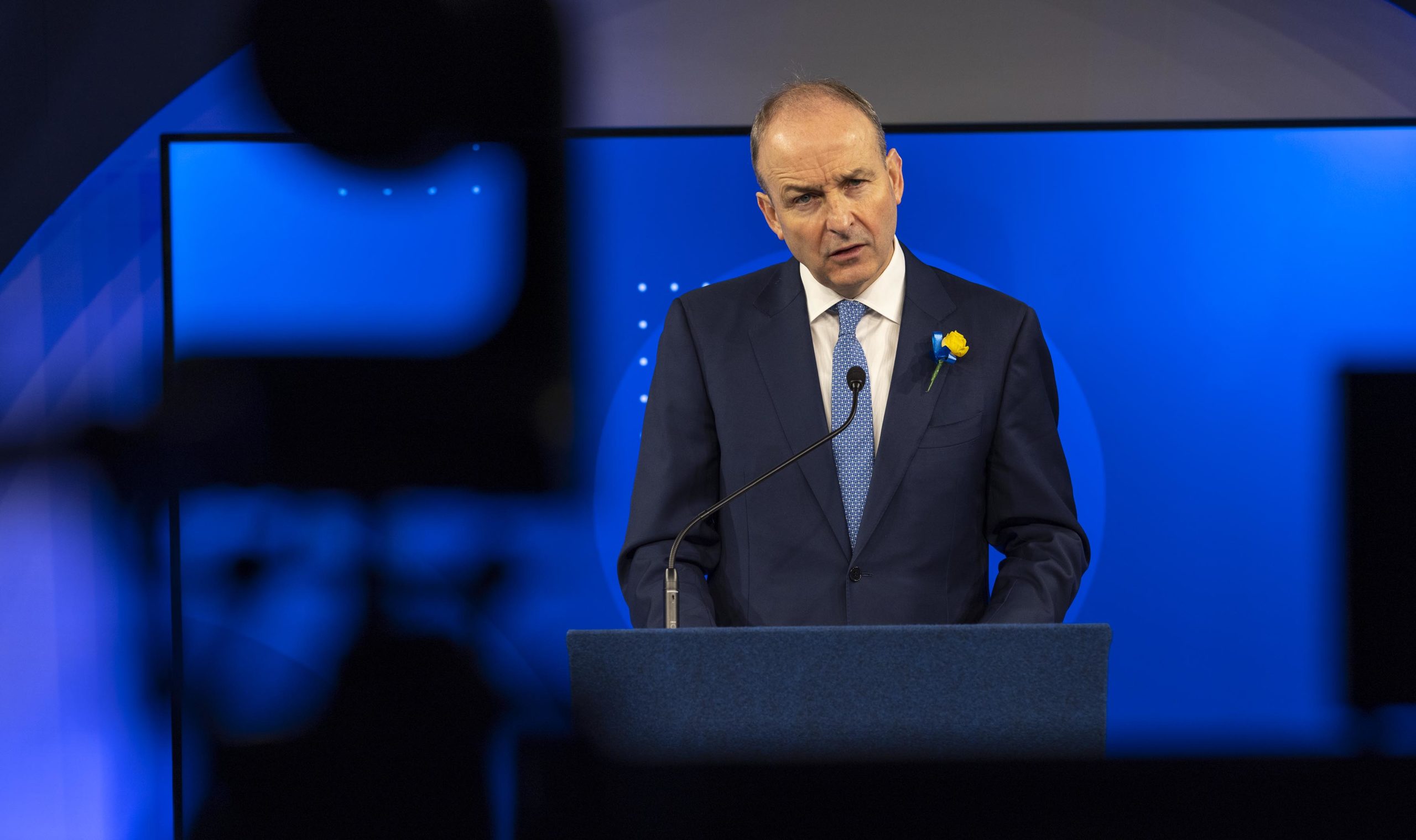
File photo
Speech of An Taoiseach, Micheál Martin TD, on Saturday 6th June 2026 at Cork City Hall on the occasion of the Cork Commemoration of the Centenary of the Foundation of Fianna Fáil
First of all, let me thank everyone who has worked so hard to organise this evening and also thank you all for being here.
This special centenary year for Fianna Fáil has seen many events at national and local level. We’ve talked about the foundation and record of this republican party.
We have celebrated great figures and also achievements which continue to inspire us and which helped to transform our country and its place in the world.Tonight we will reflect on that national and international impact – but we can also honour those who came before us and talk about the growth and impact of the party here in Cork.
By any measure, Cork was always going to be difficult ground for Fianna Fáil to grow. But we did grow, and win the strong support of the people of Cork. We did this because of a brilliant generation of leaders who overcame every obstacle in their way.
And we did it because of the strength and dedication of our members.Throughout the last century the one thing which has distinguished Fianna Fáil most of all from other parties has been our members and supporters. No history which focuses just on leaders or those who have held office can come close to understanding Fianna Fáil.
Because of our members, and the mandate to govern which they secured for us, Fianna Fáil has been recognised as one of the most successful parties in the democratic world over the last 100 years.
We are one of the few parties which led governments in the first half of the twentieth century and continue to do so. Today we are represented at every level of government and have the largest number of elected representatives.In looking at this the first thing to understand is that there was nothing inevitable about this. It did not happen by chance. In fact no other party had to overcome so many deep obstacles to growth in its early years.
We had no money, no organisation, no headquarters and faced the assertive opposition of both the media and the government.
Eamon de Valera and his colleagues had left a party which had in place a well established organisation and clear public support.But they were united by the idea that if everyone refused to change then nothing could progress.
De Valera wrote to a friend in America that it was their duty to try new approaches otherwise Ireland would not recover from what he described as “the weariness and apathy of the people after the long struggle”.
As Seán Lemass wrote at the same time:
“There are some who would have us sit by the roadside and debate abstruse points about de jure this and de facto that, but the reality we want is away in the distance — and we cannot get there unless we move.”
Wherever you look in the records of the words and actions of the men and women who founded Fianna Fáil it is hard not to be struck by this core republican idea. The idea that what matters most is delivering progress for the people.
This stood in contrast to the prevailing idea that you had to be rigidly loyal to some ideology or textbook written in very different times.
Well before others did, they embraced the idea that social and economic objectives should go together. They would never have been able to sum up their programme in a slogan – but they believed, correctly, that the Irish people were well capable of engaging with a complex and thoughtful programme.
They revered the leadership and sacrifices not just of lost friends and families but of republican figures since Wolf Tone.
However, they believed that the very essence of a living tradition was to be able to move on.Take for example Constance Markiewicz. A leader in the labour movement, in 1916 and in the Dáil, she had also written foundational texts on nationalism, republicanism and the rights of women. The very last thing she wanted in 1926 was for the causes she believed in to become stuck by following the agenda she herself had helped write in the decades before.
When she took the Chair at the first meeting of Fianna Fáil she understood fully that it meant moving on.
The fact that a century later there are others who try and claim her for their own inflexible tradition is a cynical misrepresentation of history. In an act of very special revisionism, one particular party actually sells posters, mugs and badges of the founding chairperson of Fianna Fáil.
Surely it is a testament to the stature and integrity of those who founded our party that others keep trying to steal them?
Markiewicz and her colleagues wanted to reach people outside of the boundaries of the civil war and to take a more radical approach to both asserting Irish sovereignty and addressing national needs.
Eamon de Valera’s speech at the Party’s founding meeting was a combination of dealing with the politics of the moment and steering people towards a very different direction.Ultimately his objective was to bring into power a radical government which would assert sovereignty, address pressing social concerns and develop employment through new industries. He succeeded in a manner which remains one of the greatest achievements in our democratic history.
Those who rallied to his side were remarkably gifted organisers and tacticians.
They promised that their new national movement would be built on a foundation of community activists in every part of the country. Where the government controlled patronage and the established media, they would outwork them on the ground and in the quality of their programme.They also committed themselves to respecting each other – developing a widely noted commitment to expressing different opinions in a constructive way. As the archives show, the party constantly debated policy and disagreed on important points – but only a few ever questioned the good faith and dedication of those they debated.
This was very different from what had been normal practice in Irish political movements.Cork represented what was probably the new party’s greatest challenge. This was true for many reasons.
One was, obviously, the status of Michael Collins as the great fallen hero of the new state. His loss was mourned by people on all sides of the political divide, and the party which claimed his mantle was by far the strongest here.
There was also other robust political interests – which made Cork one of the most diverse electoral contests in the country.
In the 1922 elections, republicans had won only four out of fifteen seats – and here in the city had come a poor third. A similar result followed in 1923 and also in the party’s first election in June 1927. In that election we won only 14% – half the level of support we got in the rest of the country.It showed that for Fianna Fáil to succeed in its national ambitions we needed to build a much stronger presence in Cork.
The story of how Cork became a foundation for the party is one which involves many important figures – but most of all it involves a generous and open approach to dealing with the civil war.
The single biggest error people make about Irish politics is to talk about the supposed dominance of a civil war divide in everything.The fact is that Irish politics actually became defined by the remarkable willingness to move beyond the civil war – and the growth of Fianna Fáil would simply not have been possible without the determination of our founders to welcome people from other traditions.
In the late 60’s one of the first political polls ever conducted in Ireland showed that Fianna Fáil’s support base included large numbers of people who had either supported the Treaty or had close members of their family who had supported the Treaty.
This is one of the least recognised and studied elements of the political change represented by the growth and success of Fianna Fáil.
In American political history the civil war is seen as having been at the centre of political campaigns for over half a century.
The tactic of what was termed “waving the bloody shirt” was successful time and again. In contrast to that, while of course there was some civil war rhetoric, the approach here was very different.
One newspaper reported that Lemass said during an election speech in 1927:
“anybody who comes before the people and refers to incidents in the Civil War, to try to fan back to flame the dying fires of hatred, should be turned down as a public enemy”.
This was a powerful sentiment here in Cork, where Fianna Fáil grew specifically because it enabled people to support the party without having to reject their past allegiances.
Throughout those early years you find examples of important Cork political and cultural figures who converted to Fianna Fáil well before the party held power.
On a national level this was so much the case that two of the five people who actually signed the Treaty, Robert Barton and Charles Gavan Duffy, became personal advisors and supporters of Eamon de Valera and Fianna Fáil.
Here in Cork we also saw the ability of the party to win over some of those who had opposed the new direction in 1926.
David Kent, TD for Cork East and one of the heroic Kents of 1916, refused to join the party and in June 1927 was one of the last people elected as an abstentionist Sinn Fein Deputy.
Yet soon afterwards he decided to withdraw from electoral politics and his brother William joined Fianna Fáil, becoming one of our first TDs in the East of the County.
What inspired a lot of people in those days was the way in which Fianna Fáil uniquely combined different ideas in its vision for the country.
A long-term vision of a successful Ireland, strong at home and active abroad.
No other party was founded with such diverse and ambitious programme.As a central part of this, the new party rejected the narrow and exclusionary nationalism – as well as the growing extremism – which was developing rapidly elsewhere and amongst those who yearned for simple left/right politics.
A strong belief in international law and an inclusive definition of the nation was there from the very beginning.
Within just over a decade Fianna Fáil had not only become the majority party, it had implemented a truly radical series of economic, social and constitutional policies.
This was the only case in Europe of a revolutionary group achieving power democratically and then actually strengthening the democracy.
Guaranteeing rights to all citizens, introducing the strong separation of powers between the judiciary and the political system and drafting the first democratic constitution in the world ratified through a free referendum. These are not small things, especially in the context of 1930s Europe.
One thing that was also present from the very beginning was a belief that the day-to-day challenge of ensuring that the state functions had to be a priority, even if it never won a headline.In Ronan McGreevy’s recent Lemass book he includes lengthy excerpts from interviews with him conducted just after he retired. One of the themes which runs through it is that a deputy, minister or Taoiseach who is doing their job has to understand that getting the country through crises and dealing with practical day-to-day challenges is the first and most under-appreciated task.
In these interviews he speaks with great authenticity and directness about decisions which made the biggest difference – and the fact that few of them were ever in headlines.
The very same idea comes through the excellent recent biography of James Ryan – one of the most important leaders for the party over its first fifty years.
While there are extensive archives for de Valera, and he cooperated closely with some biographers, it is a great pity that we do not have similar lengthy and private interviews with him to draw upon.
His exceptional, and truly unique leadership in securing our economic and political sovereignty as a democratic republic can be seen from his actions. Underpinning this was a remarkable commitment to making government function.
There are many, many areas where members of Fianna Fáil take great pride in a record of practical patriotism on behalf of the people.
It is a simple fact that that Ireland has gone from being the poorest country in Europe to holding records in employment, life span, educational attainment and public investment.
Nearly a quarter of a million more people call Cork their home than lived here on the day our party was formed.We have become a world-leading centre in advanced technology, research and international trade – while also being world-renowned for the quality and innovation of our more traditional industries.
The partnership between Fianna Fáil and Cork is a long and proud one and it is central to the transformation of the last century, as it is in the present and will be for the years and decades to come.
You can see it in our programme of transformative investment in public transport for the city and county, the strategic investment in the Tyndall Institute and our education institutions, the massive home-building and utility development programme that is underway and growing year on year, the multimillion euro regeneration of the Cork Docklands, or the once in a generation refurbishment of cultural institutions like the Crawford Gallery.In May 1926 a group of republicans gathered to take a risk and to show faith in the idea that a new, positive future for Ireland could be built.
A practical programme to deliver social and economic progress – and to ensure that Ireland has a strong voice in the world.
Today as much as ever, this is the commitment of Fianna Fáil.